MCQ
When light of wavelength $\lambda$ is incident on an equilateral prism kept in its minimum deviation position, it is found that the angle of deviation equals the angle of the prism itself. The refractive index of the material of the prism for the wavelength $\lambda$ is, then
  • $\sqrt{3}$
  • B
    $\frac{\sqrt{3}}{2}$
  • C
    $2$
  • D
    $\sqrt{2}$

Answer

Correct option: A.
$\sqrt{3}$
$\sqrt{3}$

Need a full question paper?

Generate a complete, print-ready paper with questions like this in minutes — across 16+ boards, with answer keys.

Start Generating Free

Similar questions

If $E$ is the electric field intensity of an electrostatic field, then the electrostatic energy density is proportional to
Two particle of mass m and 2m moving in opposite direction collide head on. They have same de-Broglie wavelength before collision after the collision.
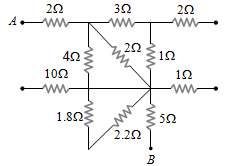
What is the equivalent resistance between the points $A$ and $B$ of the network
The energy of a charged capacitor resides in(a) The electric field only
 (b) The magnetic field only(d) Neither in electric nor magnetic field(d) Neither in electric nor magnetic field
   
   
In a two slit experiment with monochromatic light fringes are obtained on a screen placed at some distance from the sits. If the screen is moved by $5 \times 10^{-2}$towards the slits, the change in fringe width is $3 \times 10^{-5} m$. If separation between the slits is $10^{-3} m$, the wavelength of light used is
Which of the following effects could not be explained by Maxwell's electromagnetic wave theory?
If you are provided three resistances $2 W, 3 W$ and $6 W$. How will you connect them so as to obtain the equivalent resistance of $4 W$
In the absence of other conductors, the surface charge density(a) Is proportional to the charge on the conductor and its surface area(b) Inversely proportional to the charge and directly proportional to the surface area(c) Directly proportional to the charge and inversely proportional to the surface area(d) Inversely proportional to the charge and the surface area


The mass of a particle is 400 times than that of an electron and the charge is double. The particle is accelerated by 5 V. Initially the particle remained in rest, then its final kinetic energy will be(a) 5 eV(b) 10 eV(c) 100 eV(d) 2000 eV
       
Lateral displacement of the emergent ray of light increases with: