Question
When no current is passed through a conductor:
  1. The free electrons do not move.
  2. The average speed of a free electron over a large period of time is zero.
  3. The average velocity of a free electron over a large period of time is zero.
  4. The average of the velocities of all the free electrons at an instant is zero.
Answer

  1. The average velocity of a free electron over a large period of time is zero.
  2. The average of the velocities of all the free electrons at an instant is zero.

Explanation:

No current is passed through a conductor means. That the average velocity of a free elecron over a large period of time is zero or the average of the velocity of all the free electrons at an instant is zero.

Need a full question paper?

Generate a complete, print-ready paper with questions like this in minutes — across 16+ boards, with answer keys.

Start Generating Free

Similar questions

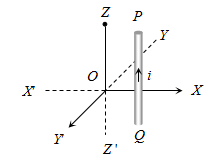
A vertical wire kept in Z-X plane carries a current from Q to P (see figure). The magnetic field due to current will have the direction at the origin O along

(a) OX

(b)  

(c) OY

(d)  

An electron is traveling along the x - direction. It encounters a magnetic field in the y - direction. Its subsequent motion will be:
The short range attractive nuclear forces that are responsible for the binding of nucleons in a nucleus are supposed to be caused by the role played by the particles called:
Which among the following is true?
I a.m.u. is equivalent to the energy of :
A river is flowing from west to east at a speed of 5 metres per minute. A man on the south bank of the river, capable of swimming at 10 metres per minute in still water, wants to swim across the river in the shortest time. He should swim in a direction:
  1. Due north.
  2. 30° east of north.
  3. 30° north of west.
  4. 60° east of north.

de-Broglie wavelength of a body of mass m and kinetic energy E is given by

(a)  

(b)

 (c)

(d)

Between the plates of a parallel plate capacitor a dielectric plate is introduced just to fill the space between the plates. The capacitor is charged and later disconnected from the battery. The dielectric plate is slowly drawn out of the capacitor parallel to the plates. The plot of the potential difference across the plates and the length of the dielectric plate drawn out is

(a)

(b)

(c)

(d)

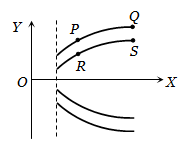
In Thomson spectrograph experiment, four positive ions P,Q,R and S are situated on Y-X curve a shown in the figure

(a) The specific charge of R and S are same

(b) The masses of P and S are same

(c) The specific charges of Q and R are same

(d) The velocities of R and S are same

Assertion  :   A parallel plate capacitor is connected across battery through a key. A dielectric slab of constant K is introduced between the plates. The energy which is stored becomes K times.

Reason     : The surface density of charge on the plate remains constant or unchanged.

(a) If both assertion and reason are true and the reason is the correct explanation of the assertion.

(b) If both assertion and reason are true but reason is not the correct explanation of the assertion.

(c) If assertion is true but reason is false.

(d) If the assertion and reason both are false.