MCQ
When one light ray is reflected from a plane mirror with $30^{\circ}$ angle of reflection, the angle of deviation of the ray after reflection is $.....^{\circ}$
  • A
    $140$
  • $120$
  • C
    $110$
  • D
    $130$

Answer

Correct option: B.
$120$
b
$\delta=180^{\circ}-60^{\circ}=120^{\circ}$

Need a full question paper?

Generate a complete, print-ready paper with questions like this in minutes — across 16+ boards, with answer keys.
Start Generating Free

Similar questions

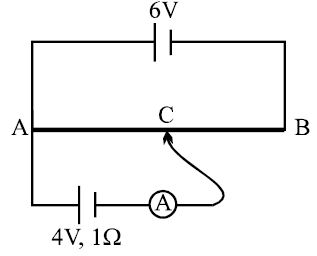
$A \,6 \,V$ battery of negligible internal resistance is connected across a uniform wire of length $1\, m$. The positive terminal of another battery of emf $4\,V$ and internal resistance $1\, \Omega$ is joined to the point $A$ as shown in figure. The ammeter shows zero deflection when the jockey touches the wire at the point $C$. The $AC$ is equal to
$X-$ rays are known to be electromagnetic radiations. Therefore the $X-$ ray photon has
Image formed by a convex mirror is
In an $X-$ rays tube, the intensity of the emitted $X-$ rays beam is increased by
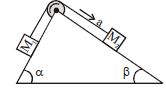
Two masses $M_1$ and $M_2$ are attached to the ends of a string which passes over a pulley attached to the top of a double inclined plane of angles of inclination $\alpha $ and $\beta $. If $M_2 > M_1$, the acceleration $a$ of the system is given by
When a battery is connected to a $P$ - type semiconductor with a metallic wire, the current in the semiconductor $(predominantly)$, inside the metallic wire and that inside the battery respectively due to
A solid cylinder of length $L$ and radius $r$ is heat upto same temperature as that of a cube of edge length $a$. If both have same material, volume and allowed to cool under similar conditions, then ratio of amount of radiations radiated will be (Neglect radiation emitted from flat surfaces of the cylinder)
When electron beam passes through an electric field, they gain kinetic energy. If the same beam passes through magnetic field, then
The wavelength of the matter wave is independent of
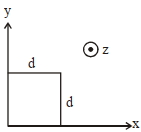
The magnetic field in a region is given by $\overrightarrow{ B }= B _{0}\left(\frac{ x }{ a }\right) \,\hat{ k }$. A square loop of side $d$ is placed with its edges along the $x$ and $y$ axes. The loop is moved with a constant velocity $\overrightarrow{ v }= v _{0} \hat{ i }$. The emf induced in the loop is: