MCQ
When potential difference is applied across an electrolyte, then Ohm's law is obeyed at:
- AZero potential.
- BVery low potential.
- CNegative potential.
- DHigh potential.
Explanation:
When voltage is applied to an electrolyte, dissociation of ions starts.
At low voltages as the voltage increases the number of ions conducting also increases making a non linear increase of current.
After a certain voltage when the ions are dissociated and no more dissociation, the electrolyte behaves as a conductor and obeys ohm's law.
Thus at high voltages, an electrolyte obeys ohm's law.
Generate a complete, print-ready paper with questions like this in minutes — across 16+ boards, with answer keys.
Assertion : Bohr had to postulate that the electrons in stationary orbits around the nucleus do not radiate.
Reason : According to classical physics all moving electrons radiate.
|
(a) If both assertion and reason are true and the reason is the correct explanation of the assertion. |
|
(b) If both assertion and reason are true but reason is not the correct explanation of the assertion. |
|
(c) If assertion is true but reason is false. |
|
(d) If the assertion and reason both are false. |
A gate has the following truth table
|
P |
1 |
1 |
0 |
0 |
|
Q |
1 |
0 |
1 |
0 |
|
R |
1 |
0 |
0 |
0 |
The gate is
|
(a) NOR |
(b) OR |
(c) NAND |
(d) AND |
A 4 μF condenser is connected in parallel to another condenser of 8 μF. Both the condensers are then connected in series with a 12 μF condenser and charged to 20 volts. The charge on the plate of 4 μF condenser is
|
(a) 3.3 μC |
(b) 40 μC |
(c) 80 μC |
(d) 240 μC |
Energy of the electron in nth orbit of hydrogen atom is given by  . The amount of energy needed to transfer electron from first orbit to third orbit is
|
(a) 13.6 eV |
(b) 3.4 eV |
(c) 12.09 eV |
(d) 1.51 eV |
Monochromatic light is refracted from air into the glass of refractive index μ. The ratio of the wavelength of incident and refracted waves is
|
(a) 1 : μ |
(b) 1 : |
(c) μ : 1 |
(d) 1 : 1 |
A particle of mass M at rest decays into two particles of masses m1 and m2, having non-zero velocities. The ratio of the de-Broglie wavelengths of the particles,  is
is
|
(a) |
(b) |
(c) 1.0 |
(d) |
The resistance of a germanium junction diode whose V - I is shown in figure is 
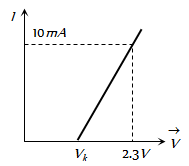
| (a) 5 kW | (b) 0.2 kW | (c) 2.3 kW |
(d) 
|


