Question
When small drops of water are sprayed, why is cooling produced?

Answer

Spraying in small drops increases the surface area. Therefore, there is an increase in the surface energy but in this work there is a decrease in the internal energy (because the total energy is conserved). Hence, the fall in temperature produces coolness, which we experience in daily life. Feeling more cold while bathing under a water fountain is an example of this.

Need a full question paper?

Generate a complete, print-ready paper with questions like this in minutes — across 16+ boards, with answer keys.
Start Generating Free

Similar questions

What is the speed of an aircraft if the pilot remains in contact with the seat, even while looping in vertical plane?
A body of mass m is placed on a table. The earth is pulling the body with a force mg. Taking this force to be the action what is the reaction?
During an experiment, an ideal gas is found to obey an additional law pV2 = constant. The gas is initially at a temperature T and volume V. Find the temperature when it expands to a volume 2V.
Water rises to a height of 10 cm in a capillary tube. If the surface tension of water is $73 \times$ $10^{-3} N / m$ and density is $1 \times 10^3 kg / m ^3$ and $g=9.8 m /$ $s^2$ then find the radius of capillary tube.
A rod of length l and mass M held vertically is let go down, without slipping at the point of contact. What is the velocity of the top end at the time of touching the ground?

A, B and C are three non-collinear, non co-planar vectors. What can you say about direction of A × (B × C)?
A block of mass 250g slides down an incline of inclination 37° with a uniform speed. Find the work done against the friction as the block slides through 1.0m.
A famous relation in physics relates 'moving mass' $m$ to the 'rest mass' $m_0$ of a particle in terms of its speed $v$ and the speed of light, $c$. (This relation first arose as a consequence of special relativity due to Albert Einstein). A boy recalls the relation almost correctly but forgets where to put the constant $c$. He writes :
$
m=\frac{m_0}{\left(1-v^2\right)^{1 / 2}}
$
Guess where to put the missing $c$.
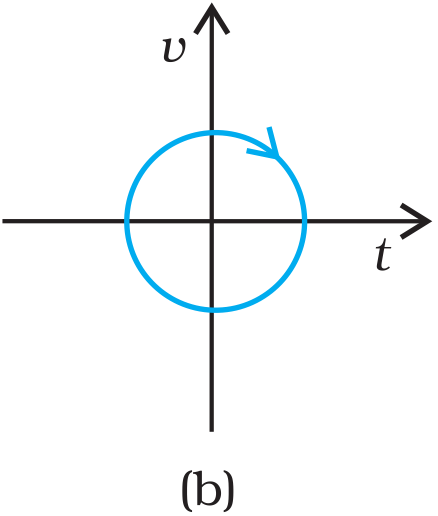
Look at the graphs carefully and state, with reasons, which of these cannot possibly represent one-dimensional motion of a particle.

An electron gun emits 2.0 × 10¹⁶ electrons per second. What electric current does this correspond to?