Question
When some wax is rubbed on a cloth, it becomes waterproof. Explain.

Answer

A liquid wets a surface when the angle of contact of the liquid with the surface is small or zero. Due to its fibrous nature, cloth produces capillary action when in contact with water. This makes clothes have very small contact angles with water. When wax is rubbed over cloth, the water does not wet the cloth because wax has a high contact angle with water.

Need a full question paper?

Generate a complete, print-ready paper with questions like this in minutes — across 16+ boards, with answer keys.
Start Generating Free

Similar questions

There are materials which absorb photons of shorter wavelength and emit photons of longer wavelength. Can there be stable substances which absorb photons of larger wavelength and emit light of shorter wavelength.
A bar magnet whose area of cross-section is $0.25 cm^2$ is kept in a magnetising field of intensity of $5000 A / m$. If magnitude of magnetic flux passing through the bar is $2.5 \times 10^{-5}$ weber, then calculate :(a) Magnetic induction (b) Magnetic susceptibility (c) Intensity of magnetisation.
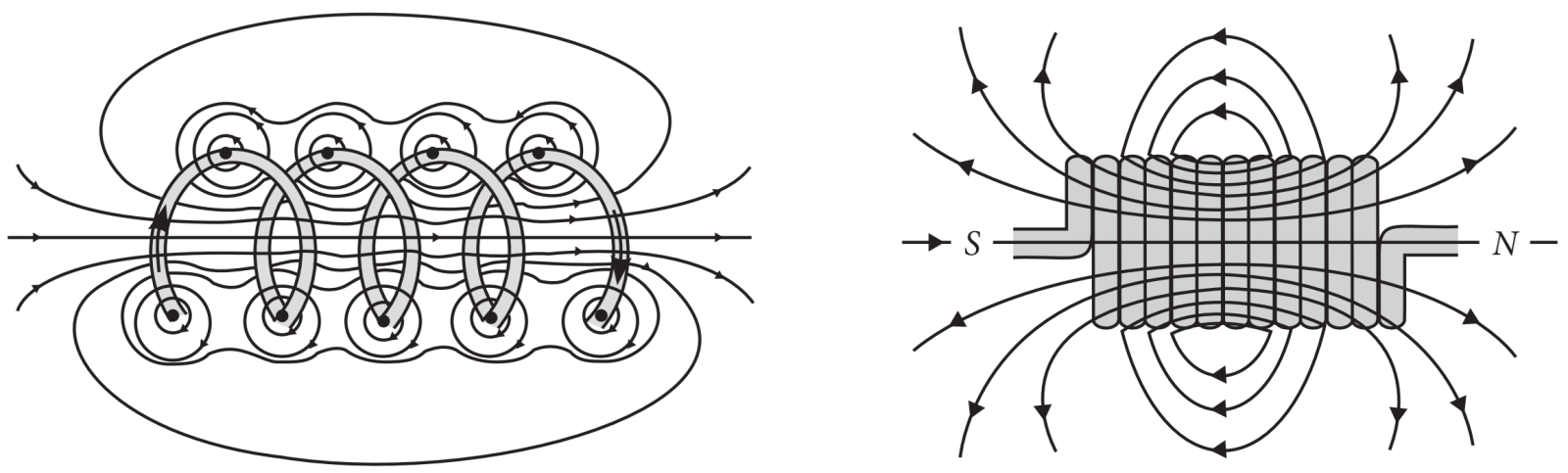
A solenoid is a long coil of wire tightly wound in the helical form. Solenoid consists of closely stacked rings electrically insulated from each other wrapped around a non$-$conducting cylinder.
Figure below shows the magnetic field lines of a solenoid carrying a steady current $I.$ We see that if the turns are closely spaced, the resulting magnetic field inside the solenoid becomes fairly uniform, provided that the length of the solenoid is much greater than its diameter. for an "ideal" solenoid, which is infinitely long with turns tightly packed, the magnetic field inside the solenoid is uniform and parallel to the axis, and vanishes outside the solenoid.
  1. A long solenoid has $800$ turns per metre length of solenoid. a current of $1.6A$ flows through it. The magnetic induction at the end of the solenoid on its axis is
  1. $10 \times 10^{-4}T$
  2. $8 \times 10^{-4}T$
  3. $32 \times 10^{-4}T$
  4. $4 \times 10^{-4}T$
  1. Choose the correct statement in the following.
  1. The magnetic field inside the solenoid is less than that of outside.
  2. The magnetic field inside an ideal solenoid is not at all uniform.
  3. The magnetic field at the centre, inside an ideal solenoid is almost twice that at the ends.
  4. The magnetic field at the centre, inside an ideal solenoid is almost half of that at the ends.
  1. The magnetic field $(B)$ inside a long solenoid having $n$ turns per unit length and carrying current $I$ when iron core is kept in it is $(\mu_0 =$ permeability of vacuum, $=$ magnetic susceptibility$)$
  1. $\mu_0\text{ nI}(\text{l}-\chi)$
  2. $\mu_0\text{ nI }\chi$
  3. $\mu_0\text{ nI}^2(\text{1}+\chi)$
  4. $\mu_0\text{ nI}(\text{1}+\chi)$
  1. A solenoid oflength land having $l$ turns carries a current $I$ is in anticlockwise direction. The magnetic field is:
  1. $\mu_0\text{ nI}$
  2. $\mu_0\frac{\text{ nI}}{\text{l}^2}$
  3. A​​​​​​along the axis of solenoid.
  4. Perpendicular to the axis of coil.
  1. The magnitude of the magnetic field inside a long solenoid is increased by:
  1. Decreasing its radius.
  2. Decreasing the current through it.
  3. Increasing its area of cross$-$section.
  4. Introducing a medium of higher permeability.
You are holding a cage containing a bird. Do you have to make less effort if the bird flies from its position in the cage and manages to stay in the middle without touching the walls of the cage? Does it make a difference whether the cage is completely closed or it has rods to let air pass?
The weight Mg of an extended body is generally shown in a diagram to act through the centre of mass. Does it mean that the earth does not attract other particles?
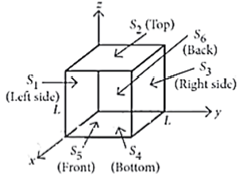
Net electric flux through a cube is the sum of fluxes through its six faces. Consider a cube as shown in figure, having sides of length $L =10.0 \ cm$. The electric field is uniform, has a magnitude $E =4.00 \times 10^3\ NC ^{-1}$ and is parallel to the $xy$ plane at an angle of $37^{\circ}$ measured from the $+ x -$axis towards the $+ y -$axis.
Image
$(i)$ Electric flux passing through surface $S_6$ is
$(a)\ -24 Nm ^2 C ^{-1}$
$(b)\ 32 Nm ^2 C ^{-1}$
$(c)\ -32 Nm ^2 C ^{-1}$
$(d)\ 24 Nm ^2 C ^{-1}$
$(ii)$ Electric flux passing through surface $S_1$ is
$(a)\ -32\  Nm ^2 C ^{-1}$
$(b)\ -24 \ Nm ^2 C ^{-1}$
$(c)\ 32 \ Nm ^2 C ^{-1}$
$(d)\ 24 \ Nm ^2 C ^{-1}$
$(iii)$ The surfaces that have zero flux are
$(a)\ S _2$ and $S _4$
$(b)\ S_3$ and $S_6$
$(c)\ S _1$ and $S _2$
$(d)\ S _1$ and $S _3$
$(iv)$ he total net electric flux through all faces of the cube is $(a)24\ Nm 2 C-1 (c)-8\ Nm2 C-1 b$
$(a)\ 24\ Nm ^2 C ^{-1}$
$(b)\ 8\ Nm ^2 C ^{-1}$
$(c)\ -8\ Nm ^2 C ^{-1}$
$(d)$ zero
$OR$
The dimensional formula of surface integral $\oint \vec{E} \cdot d \vec{S}$ of an electric field is
$(a)\ \left[ M ^{-1} L^3 T^{-3} A\right]$
$(b)\ \left[ M L ^2 T^{-2} A^{-1}\right]$
$(c) \ \left[ ML ^3 T^{-3} A^{-1}\right]$
$(d)\ \left[ M L ^{-3} T^{-3} A^{-1}\right]$
Out of the two magnetic materials, 'A' has relative permeability slightly greater than unity while 'B' has less than unity. Identify the nature of the materials 'A' and 'B'. Will their susceptibilities be positive or negative?
For the $L - C - R$ series $AC$ circuit derive the phase relationship between instantaneous current and voltage, using the phasor diagram.
At what angle should a ray of light be incident on the face of a prism of refracting angle 60° so that it just suffers total internal reflection at the other face? The refractive index of the material of the prism is 1.524.
Suppose the density of air at Madras is $P_0$ and atomospheric pressure is $P_0.$ If we go up, the density and the pressure both decrease. Suppose we wish to calculate the pressure at a height $10\ km$ above Madras. If we use the equation $P_{0 }- P = pogz,$ will we get a pressure more than the actual or less than the actual? Neglect the variation in $g.$ Does your answer change if you also consider the variation in $g$?