Question
When subatomic particles undergo reactions, energy is conserved, but mass is not necessarily conserved. However, a particle's mass “contributes” to its total energy, in accordance with Einstein's famous equation, E = mc2 In this equation, E denotes the energy carried by a particle because of its mass. The particle can also have additional energy due to its motion and its interactions with other particles. Consider a neutron at rest and well separated from other particles. It decays into a proton, an electron and an undetected third particle as given here: Neutron → proton + electron + ???

The given table summarizes some data from a single neutron decay. Electron volt is a unit of energy. Column 2 shows the rest mass of the particle times the speed of light squared.

Particle
Mass × c2 (MeV)
Kinetic energy (MeV)
Neutron
940.97
0.00
Proton
939.67
0.01
Electron
0.51
0.39
  1. From the given table, which properties of the undetected third particle can be calculate?
  1. Total energy, but not kinetic energy.
  2. Kinetic energy, but not total energy.
  3. Both total energy and kinetic energy.
  4. Neither total energy nor kinetic energy.
  1. Assuming the table contains no major errors, what can we conclude about the (mass × c2) of the undetected third particle?
  1. It is 0. 79 MeV
  2. It is 0.39 MeV
  3. It is less than or equal to 0.79 MeV; but we cannot be more precise.
  4. It is less than or equal to 0.40 MeV; but we cannot be more precise.
  1. Could this reaction occur?

Proton → neutron + other particles

  1. Yes, if the other particles have much more kinetic energy than mass energy.
  2. Yes, but only if the proton has potential energy (due to interactions with other particles). 
  3. No, because a neutron is more massive than a proton.
  4. No, because a proton is positively charged while a neutron is electrically neutral.
  1. How much mass has to be converted into energy to produce electric power of 500MW for one hour?
  1. 2 × 10-5kg
  2. 1 × 10⁻⁵kg
  3. 3 × 10⁻⁵kg
  4. 4 × 10⁻⁵kg
  1. The equivalent energy of 1g of substance is.
  1. 9 × 10¹³J
  2. 6 × 10¹²J
  3. 3 × 10¹³J
  4. 6 × 10¹³J

Answer

  1. (a) Total energy, but not kinetic energy.

Explanation:

As just shown, energy conservation allows us to calculate the third particle's total energy. But we do not know what percentage of that total is mass energy. 

  1. (d) It is less than or equal to 0.40 MeV, but we cannot be more precise.

Explanation:

According to the passage, subatomic reactions do not conserve mass. So, we cannot find the third particle's mass by setting $\text{m}_\text{neutron}$equal to $\text{m}_\text{proton}+\text{m}_\text{electron}+\text{E}_\text{thrid particle}$

The neutron has energy 940.97 MeV. The proton has energy 939.67 MeV + 0.01 MeV = 939.69 MeV. The electron has energy 0.51 MeV + 0.39 MeV = 0.90 MeV. Therefore, the third particle has energy.

$\text{E}_\text{third particle}=\text{E}_\text{neutron}-\text{E}_\text{proton}-\text{E}_\text{electron}$

= 940.97 - 939.67 - 0.90 = 0.40 MeV 

We just found the third particle's total energy, the sum of its mass energy and kinetic energy. Without more information, we cannot figure out how much of that energy is mass energy.

  1. (b) Yes, but only if the proton has potential energy (due to interactions with other particles). 
  2. (a) 2 × 10-5kg

Explanation:

Here, P = 500MW = 5 × 10⁸W,

t = 1h = 3600s

Energy produced, E = P × t = 5 × 108 × 3600 = 18 × 1011J

$\text{As}\ \text{E}=\Delta\text{mc}^2$

$\therefore\Delta\text{m}=\frac{\text{E}}{\text{c}^2}=\frac{18\times10^{11}}{(3\times10^8)^2}$

$=\frac{18\times10^{11}}{(3\times10^8)^{16}}=2\times10^{-5}\text{kg}$

  1. (a) 9 × 10¹³J

Explanation:

Using, E = mc2

Here, m = 1g = 1 × 10⁻³kg, c = 3 × 10⁸m s-1

$\therefore$ E = 10-3 × 9 × 1016 = 9 × 1013J

Need a full question paper?

Generate a complete, print-ready paper with questions like this in minutes — across 16+ boards, with answer keys.

Start Generating Free

Similar questions

In motor vehicles, a convex mirror is attached near the driver's seat to give him the view of the traffic behind. What is the special function of this convex mirror which a plane mirror can not do?
A solenoid 60 cm long and of radius 4.0 cm has 3 layers of windings of 300 turns each. A 2.0 cm long wire of mass 2.5 g lies inside the solenoid (near its centre) normal to its axis; both the wire and the axis of the solenoid are in the horizontal plane. The wire is connected through two leads parallel to the axis of the solenoid to an external battery which supplies a current of 6.0 A in the wire. What value of current (with appropriate sense of circulation) in the windings of the solenoid can support the weight of the wire? g = 9.8 m s–2.
  1. A mobile phone lies along the principal axis of a concave mirror. Show, with the help of a suitable diagram, the formation of its image. Explain why magnification is not uniform.
  2. Suppose the lower half of the concave mirror's reflecting surface is covered with an opaque material. What effect this will have on the image of the object? Explain.
At what angle should a ray of light be incident on the face of a prism of refracting angle 60° so that it just suffers total internal reflection at the other face? The refractive index of the material of the prism is 1.524.
Two friends A and B are standing a distance x apart in an open field and wind is blowing from A to B. A beats a drum and B hears the sound t1 time after he sees the event. A and B interchange their positions and the experiment is repeated. This time B hears the drum t2 time after he sees the event. Calculate the velocity of sound in still air v and the velocity of wind u. Neglect the time light takes in travelling between the friends.
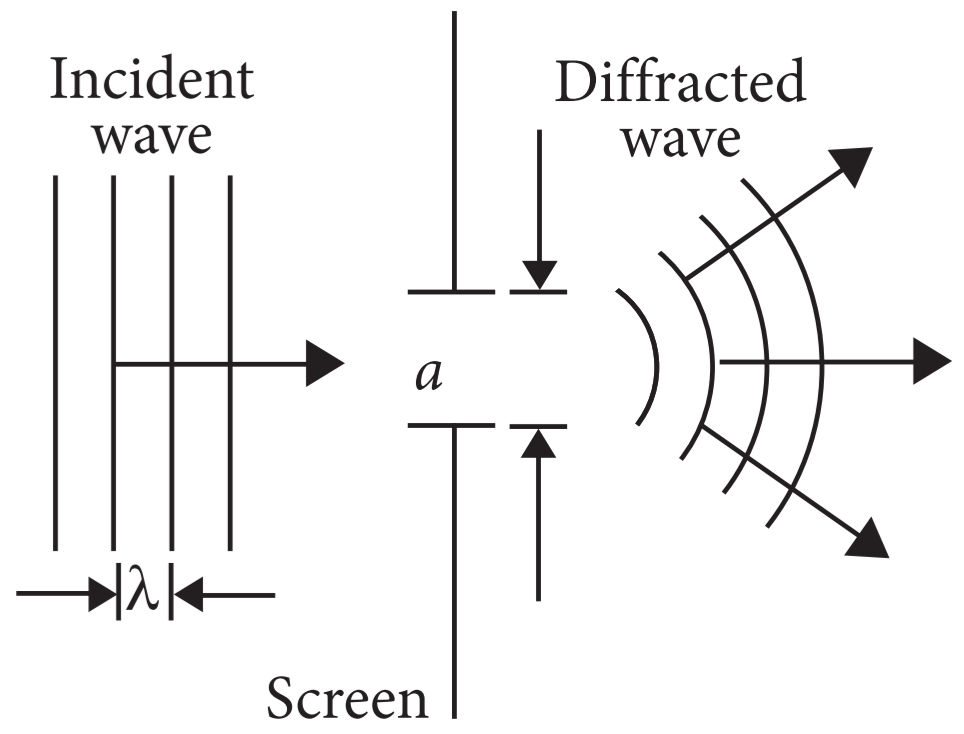
The phenomenon of bending ofli ght around the sharp corners and the spreading of light within the geometrical shadow of the opaque obstacles is called diffraction of light. The light thus deviates from its linear path. The deviation becomes much more pronounced, when the dimensions of the aperture or the obstacle are comparable to the wavelength of light.

  1. Light seems to propagate in rectilinear path because.
  1. Its spread is very large.
  2. Its wavelength is very small.
  3. Reflected from the upper surface of atmosphere.
  4. It is not absorbed by atmosphere.
  1. ln diffraction from a single slit the angular width of the central maxima does not depends on:
  1. $\lambda$ of light used.
  2. Width of slit.
  3. Distance of slits from the screen.
  4. Ratio of $\lambda$ and slit width.
  1. For a diffraction from a single slit, the intensity of the central point is:
  1. Infinite.
  2. Finite and same magnitude as the surrounding maxima.
  3. Finite but much larger than the surrounding maxima.
  4. Finite and substantially smaller than the surrounding maxima.
  1. Resolving power of telescope increases when:
  1. Wavelength of light decreases.
  2. Wavelength of light increases.
  3. Focal length of eye-piece increases.
  4. Focal length of eye-piece decreases.
  1. ln a single diffraction pattern observed on a screen placed at D metre di stance from the slit of width d metre, the ratio of the width of the central maxima to the width of other secondary maxima is:
  1. 2 : 1
  2. 1 : 2
  3. 1 : 1
  4. 3 : 1
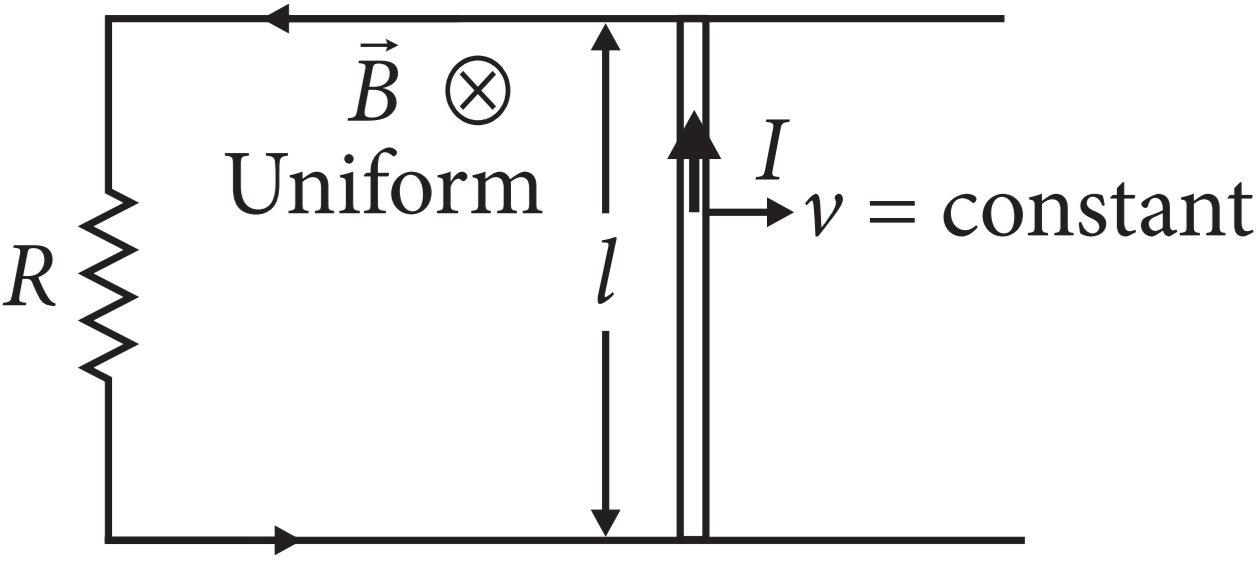
The emf induced across the ends of a conductor due to its motion in a magnetic field is called motional emf. It is produced due to the magnetic Lorentz force acting on the free electrons of the conductor. For a circuit shown in figure, if a conductor of length l moves with velocity v in a magnetic field B perpendicular to both its length and the direction of the magnetic field, then all the induced parametres are possible in the circuit.

  1. Direction of current induced in a wire moving in a magnetic field is found using
  1. Fleming's left hand rule.
  2. Fleming's right hand rule.
  3. Ampere's rule.
  4. Right hand clasp rule.
  1. A conducting rod of length l is moving in a transverse magnetic field of strength B with velocity v. The resistance of the rod is R. The current in the rod is:
  1. $\frac{\text{Blv}}{R}$

  2. $\frac{\text{B}^2\text{v}^2\text{l}^2}{\text{R}}$

  3. Blv
  4. Zero
  1. A 0.1m long conductor carrying a current of SO A is held perpendicular to a magnetic field of 1.25mT. The mechanical power required to move the conductor with a speed of I m s-1 is:
  1. 62.5 mW
  2. 625 mW
  3. 6.25 mW
  4. 12.5 mW
  1.  A bicycle generator creates 1.5 Vat 15km/ hr. The EMF generated at 10km/ hr is:
  1. 1.5 volts
  2. 2 volts
  3. 0.5 volts
  4. 1 volt
  1. The dimensional formula for emf E in MKS system will be:
  1. [ML2T-3A-1]
  2. [ML2T-1A]
  3. [ML2A]
  4. [MLT-3A-1]
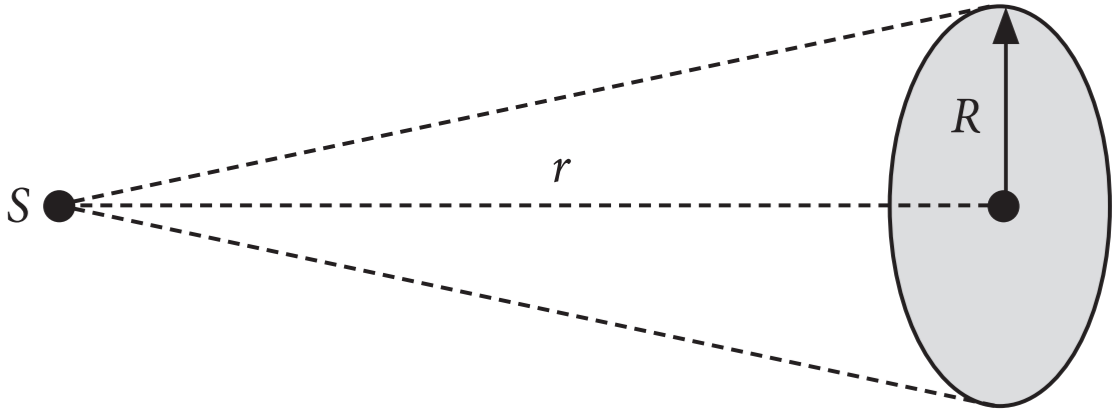
A point sources of power 6.4 × 10⁻³W emits mono energetic photons each of energy 6.0eV. The source is located at a distance of 0.8m from the centre of a stationary metallic sphere of work function 3.0eV and of radius 1.6 × 10⁻³m mas shown in figure. The sphere is isolated and initially neutral and photoelectrons are instantly taken away from sphere after emission. The efficiency of photoelectric emission is one for very 105 incident photons.

  1. The power received by the sphere through radiations is:
  1. $\frac{\text{R}^2}{\text{Pr}}$
  2. $\frac{\text{PR}^2}{4\text{r}^2}$
  3. $\frac{\text{P}^2\text{R}}{2\pi\text{r}}$
  4. $\frac{\text{PR}}{4\text{r}}$
  1. Number of photons striking the metal sphere per second is:
  1. 6.7 × 109
  2. 3.3 × 10⁹
  3. 6.7 × 1010
  4. 3.3 × 10¹⁰
  1. The number of photoelectrons emitted per second is about.
  1. 3.3 × 10⁴
  2. 6.7 × 104
  3. 6.7 × 1015
  4. 3.3 × 10¹⁵
  1. The photoelectric emission stops when the sphere acquires a potential about.
  1. 2V
  2. 3V
  3. 4V
  4. 6V
  1. If the distance of source becomes double from the centre of the metal sphere then the power received by the sphere.
  1. $\frac{\text{PR}^2}{4\text{r}^2}$
  2. $\frac{\text{PR}^2}{16\text{r}^2}$
  3. $\frac{\text{PR}^2}{4\text{r}}$
  4. $\frac{\text{P}^2\text{R}^2}{16\text{r}^2}$
Total internal reflection is the phenomenon of reflection of light into denser medium at the interface of denser medium with a rarer medium. For this phenomenon to occur necessary condition is that light must travel from denser to rarer and angle of incidence in denser medium must be greater than critical angle (C) for the pair of media in contact. Critical angle depends on nature of medium and wavelength of tight. We can show that $\mu=\frac{1}{\sin\text{C}}.$
  1. Critical angle for glass air interface, where ft of glass is $\frac{3}{2}$ is,
  1. 41.8
  2. 60º
  3. 30º
  4. 15º
  1. Critical angle for water air interface is 48.6º. What is the refractive index of water?
  1. $1$
  2. $\frac{3}{2}$
  3. $\frac{4}{3}$
  4. $\frac{3}{4}$
  1. Critical angle for air water interface for violet colour is 49º. Its value for red colour would be:
  1. 49º
  2. 50º
  3. 48º
  4. Cannot say.
  1. Which of the following is not due to total internal reflection?
  1. Working of optical fibre.
  2. Difference between apparent and real depth of a pond.
  3. Mirage on hot summer days.
  4. Brilliance of diamond.
  1. Critical angle of glass is $\theta_1$ and that of water is $\theta_2$The critical angle for water and glass surface would be $(\mu_\text{g}=\frac{3}{2},\ \mu_\text{w}=\frac{4}{3})$
  1. Less than $\theta_2$
  2. Between $\theta_1$ and $\theta_2$
  3. Greater than $\theta_2$
  4. Less than $\theta_1$
What can be said about the centre of mass of a uniform hemisphere without making any calculation? Will its distance from the centre be more than $\frac{\text{r}}{2}$ or less than $\frac{\text{r}}{2}?$