Question
When subjected to a transverse electric field, cathode rays move (a) Down the potential gradient(b) Up the potential gradient(c) Along a hyperbolic path(d) Along a circular path


Answer

(b) Up the potential gradient

Need a full question paper?

Generate a complete, print-ready paper with questions like this in minutes — across 16+ boards, with answer keys.
Start Generating Free

Similar questions

Out of the following statements which is not correct(a) When unpolarised light passes through a Nicol's prism, the emergent light is elliptically polarised (b) Nicol's prism works on the principle of double refraction and total internal reflection (c) Nicol's prism can be used to produce and analyse polarised light(d) Calcite and Quartz are both doubly refracting crystals


If an insulated non$-$conducting sphere of radius $R$ has charge density $\rho$. The electric field at a distance $r$ from the centre of sphere $( r<R )$ will be
Two circuits have mutual inductance of 0.1 H. What average e.m.f. is induced in one circuit when the current in the other circuit changes from 0 to 20 A in 0.02 s(a) 240 V                                            (b) 230 V(c) 100 V(d) 300 V
       
Like coulomb force, ______ also satisfies superposition principle.
The cellular mobile radio frequency band is:
A thin lens is made with a material having refractive index $\mu=1.5.$ Both the sides are convex. It is dipped in water $(\mu=1.33).$ It will behave like:
The arrangement fo two magnetic poles of equal and opposite strengths separated by a finite distance is called:
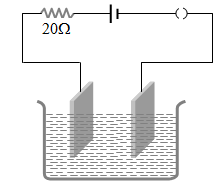
In a $Ag$ voltameter $2.68 \ gm$ of silver is deposited in $10$ min. The heat developed in $20 \Omega$ resistor during the same period will be
Assertion     :   If the distance between parallel plates of a capacitor is halved and dielectric constant is made three times, then the capacitor becomes 6 times.
Reason        : Capacity of the capacitor does not depend upon the nature of the material. (a) If both assertion and reason are true and the reason is the correct explanation of the assertion.(b) If both assertion and reason are true but reason is not the correct explanation of the assertion.(c) If assertion is true but reason is false.(d) If the assertion and reason both are false.


The reason for attractive force between two parallel wires in which current is flowing in same direction is: