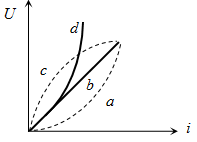
Question

When subjected to a transverse electric field, cathode rays move

(a) Down the potential gradient

(b) Up the potential gradient

(c) Along a hyperbolic path

(d) Along a circular path

Answer

(b) Up the potential gradient

Need a full question paper?

Generate a complete, print-ready paper with questions like this in minutes — across 16+ boards, with answer keys.

Start Generating Free

Similar questions

Pick out the correct statement from the following about parallel combination of resistors.
The self-inductance of a long solenoid carrying current is independent of:
Two charges of $+2 \mu C$ and $+8 \mu C$ are located at a distance of one meter. At what distance from a $2 \mu C$ charge will the electric field be zero on the line joining them?
An object can be negatively charged by:

How much water should be filled in a container 21 cm in height, so that it appears half filled when viewed from the top of the container  (given that a = 4/3)

(a) 8.0 cm

(b) 10.5 cm

(c) 12.0 cm

(d) None of the above

The relation between a and b parameters of current gains for a transistors is given by

(a) α =  

(b) α =

(c) α =

(d) α =

Which of the following plots may represent the thermal energy produced in a resistor in a given time as a function of the electric current

(a) a

(b) b

(c) c

(d) d

If a wire of resistance R is melted and recasted to half of its length, then the new resistance of the wire will be

(a) R/4    

(b) R/2

(c) R 

(d) 2R

A dip needle lies initially in the magnetic meridian when it shows an angle of dip q at a place. The dip circle is rotated through an angle x in the horizontal plane and then it shows an angle of dip . Then   is

(a)  

(b)

(c)

(d) cos x

Calculate the amount of charge flowing in 2 minutes in a wire of resistance 10 W when a potential difference of 20 V is applied between its ends

(a) 120 C 

(b) 240 C

(c) 20 C

(d) 4 C