Question
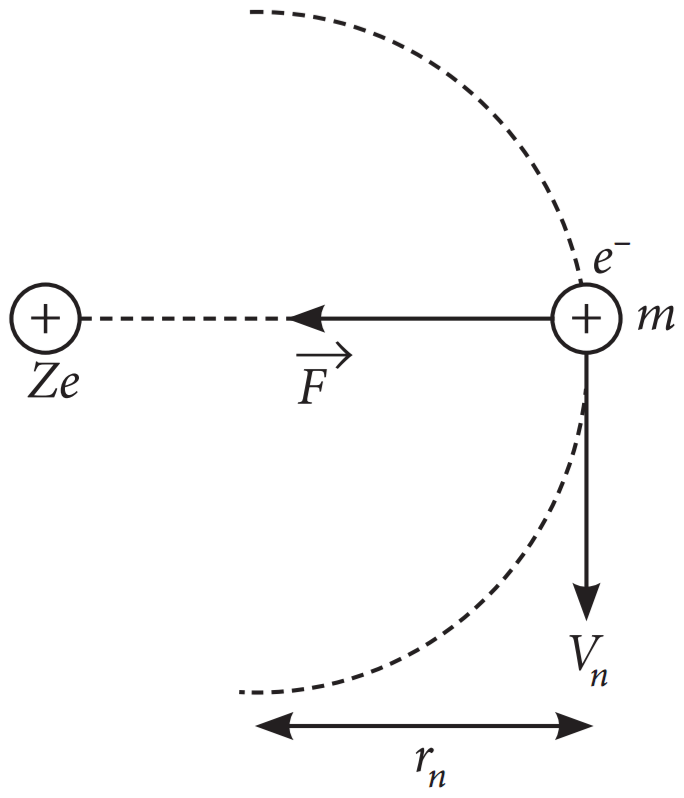
When the electron orbiting in hydrogen atom in its ground state moves to the third excited state, show how the de Broglie wavelength associated with it would be affected.

Answer

de Broglie wavelength $\lambda = \frac{\text{h}}{\text{mv}}$

$\therefore \lambda \propto\frac{1}{v} ; \text{v} \propto\frac{1}{\text{n}}$

$\therefore \lambda\propto\text{n}$

$\therefore$ 𝑑𝑒 Broglie wavelength will increase

Alternate Answer

As $2\pi\text{r}_{n} = \text{n}\lambda ; \lambda = \frac{2\pi\text{r}_{n}}{\text{n}}(\lambda\propto\frac{\text{r}_{n}}{\text{n}})$

$\text{r}_{n}\propto\text{n}^{2}$

$\therefore \lambda\propto\frac{\text{n}^{2}}{\text{n}}\Rightarrow\lambda\propto\text{n}$

$\therefore$ 𝑑𝑒 Broglie wavelength will increase.

Need a full question paper?

Generate a complete, print-ready paper with questions like this in minutes — across 16+ boards, with answer keys.

Start Generating Free

Similar questions

Find the acceleration due to gravity of the moon at a point 1000km above the moon's surface. The mass of the moon is 7.4 × 10²²kg and its radius is 1740km.
An electromagnetic wave transports linear momentum as it travels through space. If an electromagnetic wave transfers a total energy U to a surface in time t, then total linear momentum delivered to the surface is $\text{p}=\frac{\text{U}}{\text{c}}.$ When an electromagnetic wave falls on a surface, it exerts pressure on the surface. ln 1903, the American scientists Nichols and Hull succeeded in measuring radiation pressures of visible light where other had failed, by making a detailed empirical analysis of the ubiquitous gas heating and ballistic effects.
  1. The pressure exerted by an electromagnetic wave of intensity I (Wm-2) on a non-reflecting surface is (c is the velocity of light). 
  1. $\text{Ic}$
  2. $\text{Ic}^2$
  3. $\frac{\text{I}}{\text{c}}$
  4. $\frac{\text{I}}{\text{c}^2}$
  1. Light with an energy flux of $18\frac{\text{W}}{\text{cm}^2}$ falls on a non-reflecting surface at normal incidence. The pressure exerted on the surface is:
  1. $3\frac{\text{N}}{\text{m}^2}$
  2. $2\times10^{-4}\frac{\text{N}}{\text{m}^2}$
  3. $6\frac{\text{N}}{\text{m}^2}$
  4. $6\times10^{-4}\frac{\text{N}}{\text{m}^2}$
  1. Radiation of intensity 0.5Wm-2 are striking a metal plate. The pressure on the plate is:
  1. 0.166 × 10⁻⁸Nm-2
  2. 0.212 × 10⁻⁸Nm-2
  3. 0.132 × 10⁻⁸Nm-2
  4. 0.083 × 10-8Nm-2
  1. A point source of electromagnetic radiation has an average power out-put of 1500W. The maximum value of electric field at a distance of 3m from this source (in Vm-1) is:
  1. $500$
  2. $100$
  3. $\frac{500}{3}$
  4. $\frac{250}{3}$
  1. The radiation pressure of the visible light is of the order of,
  1. $10^{-2}\frac{\text{N}}{\text{m}^2}$
  2. $10^{-4}\frac{\text{N}}{\text{m}}$
  3. $10^{-6}\frac{\text{N}}{\text{m}^2}$
  4. $10^{-8}\text{N}$
If the earth's magnetic field has a magnitude 3.4 × 10-5 T at the magnetic equator of the earth what would be its value at the earth's geomagnetic poles?
A magnetic needle is free to rotate in a vertical plane which makes an angle of 60° with the magnetic meridian. If the needle stays in a direction making an angle of $\tan^{-1}\Big(\frac{2}{\sqrt{3}}\Big)$ with the horizontal, what would be the dip at that place?
The density of nuclear matter is the ratio of the mass of a nucleus to its volume. As the volume of a nucleus is directly proportional to its mass number A, so the density of nuclear matter is independent of the size of the nucleus. Thus, the nuclear matter behaves like a liquid of constant density. Different nuclei are like drops of this liquid, of different sizes but of same density. Let A be the mass number and R be the radius of a nucleus. If m is the average mass of a nucleon, then.

Mass of nucleus = mA

$\text{Volume of nucleus }=\frac{4}{3}\pi\text{R}^3=\frac{4}{3}\pi\big(\text{R}_0\text{A}\frac{1}{3}\big)=\frac{4}{3}\pi\text{R}^3_0\text{A}$

$\therefore\text{Nuclear density},\rho\text{nu}=\frac{\text{Mass of nucleus}}{\text{Volume of nucleus}}\text{or}\ \rho\text{nu}$

$=\frac{\text{MA}}{\frac{4}{3}\pi\text{R}_0^3\text{A}}=\frac{3\text{m}}{4\pi\text{R}_0^3}$

Clearly, nuclear density is independent of mass number A or the size of the nucleus. The nuclear mass density is of the order 1017kg m-3 This density is very large as compared to the density of ordinary matter, say water, for which $\rho$ = 1.0 × 103kg m-3
  1. The nuclear radius of $_8^{16}\text{O}$ is 3 × 10-15m. The density of nuclear matter is.
  1. 2.9 × 1034kg m-3
  2. 1.2 × 1017kg m-3
  3. 16 × 1027kg m-3
  4. 2.4 × 1017kg m-3
  1. What is the density of hydrogen nucleus in SI units? Given Ro= 1.1 fermi and mP = 1.007825 amu.
  1. 1.2 × 1017kg m-3
  2. 3.0 × 1034kg m-3
  3. 1.99 × 1011kg m-3
  4. 7.85 × 1017kg m-3
  1. Density of a nucleus is.
  1. More for lighter elements and less for heavier elements.
  2. More for heavier elements and less for lighter elements.
  3. Very less compared to ordinary matter.
  4. A constant.
  1. The nuclear mass of $_{23}^{56}\text{Fe}$ is 55.85 amu. The its nuclear density is.
  1. 5.0 × 1019kg m-3
  2. 1.5 × 1019kg m-3
  3. 2.9 × 1017kg m-3
  4. 9.2 × 1026kg m-3
  1. If the nucleus of $_{13}^{27}\text{Al}$ has s a nuclear radius of about 3.6 fm, then $_{52}^{125}\text{Te}$ would have its radius approximately as.
  1. 9.6fm
  2. 12fm
  3. 4.8fm
  4. 6fm
The magnetic moment of the assumed dipole at the earth's centre is 8.0 × 1022 A-m2. Calculate the magnetic field B at the geomagnetic poles of the earth. Radius of the earth is 6400km.
(a) An electron is revolving with a speed of 2 $\times 10^5 m / s$ in the orbit of radius $0.51 A$ in a hydrogen atom. Calculate the magnetic moment of the electron.
(b) Equivalent electric current due to orbital speed of electron.
(c) Magnetic field generated at the centre of the nucleus.
Hydrogen is the simplest atom of nature. There is one proton in its nucleus and an electron moves around the nucleus in a circular orbit. According to Niels Bohr, this electron moves in a stationary orbit. When this electron is in the stationary orbit, it emits no electromagnetic radiation.The angular momentum of the electron is quantized, i.e., ⁣$\text{mvr}=\big(\frac{\text{nh}}{2\pi}\big)$ where m = mass of the electron, v = velocity of the electron in the orbit, r = radius of the orbit and n = 1, 2, 3, .... When transition takes place from Kth orbit to Jth orbit, energy photon is emitted. If the wavelength of the emitted photon is $\lambda$ we find that $\frac{1}{\lambda}=\text{R}\bigg[\frac{1}{\text{J}^2}-\frac{1}{\text{K}^2}\bigg]$where find that On a different planet, the hydrogen atom's structure was somewhat different from ours. The angular momentum of electron was $\text{P}=2\text{n}\Big(\frac{\text{h}}{2\pi}\Big)$ i.e., an even multiple of $\Big(\frac{\text{h}}{2\pi}\Big)$.

  1. The minimum permissible radius of the orbit will be.
  1. $\frac{2\in_0\text{h}^2}{\text{m}\pi\text{e}^2}$
  2. $\frac{4\in_0\text{h}^2}{\text{m}\pi\text{e}^2}$
  3. $\frac{\in_0\text{h}^2}{\text{m}\pi\text{e}^2}$
  4. $\frac{\in_0\text{h}^2}{\text{2m}\pi\text{e}^2}$
  1. In our world, the velocity of electron is v0 when the hydrogen atom is in the ground state. The velocity of electron in this state on the other planet should be.
  1. $\text{v}_0$
  2. $\frac{\text{v}_0}{2}$
  3. $\frac{\text{v}_0}{4}$
  4. $\frac{\text{v}_0}{8}$
  1. In our world, the ionization potential energy of a hydrogen atom is 13.6eV. On the other planet, this ionization potential energy will be.
  1. 13.6eV
  2. 3.4eV
  3. 1.5eV
  4. 0.85eV
  1. Check the correctness of the following statements about the Bohr model of hydrogen atom.
  1. The acceleration of the electron in n = 2 orbit is more than that in n = 1 orbit.
  2. The angular momentum of the electron in n = 2 orbit is more than that in n = 1 orbit.
  3. The kinetic energy of the electron in n = 2 orbit is less than that in n = 1 orbit.
  1. Only (III) and (I) are correct
  2. Only (III) and (I) are correct
  3. Only (II) and (III) are correct.
  4. All the statements are correct.
  1. In Bohr's model of hydrogen atom, let PE represent potential energy and TE the total energy. In going to a higher orbit.
  1. PE increases, TE decreases
  2. PE decreases, TE increases
  3. PE increases, TE increases
  4. PE decreases, TE decreases
To keep valuable instruments away from the earth's magnetic field, they are enclosed in iron boxes. Explain.
In one of the exercises to strengthen the wrist and fingers, a person squeezes and releases a soft rubber ball. Is the work done on the ball positive, negative or zero during compression? During expansion?