Question
When the temperature of an object is increased slowly, why does it appear red at first?

Answer

According to Wien's law related to radiations
$\lambda_{ m } T =$ Constant
According to this if temperature T is less then the wavelength of emitted radiation $\lambda_m$ would be more. In the visible light the wavelength of red light is maximum. So when the object is heated slowly then the wavelength of emitted radiation at low temperature will be maximum so on heating an object the radiation waves with big wavelengths (of red colour in visible light) are emitted first, and the object appears red at first.

Need a full question paper?

Generate a complete, print-ready paper with questions like this in minutes — across 16+ boards, with answer keys.
Start Generating Free

Similar questions

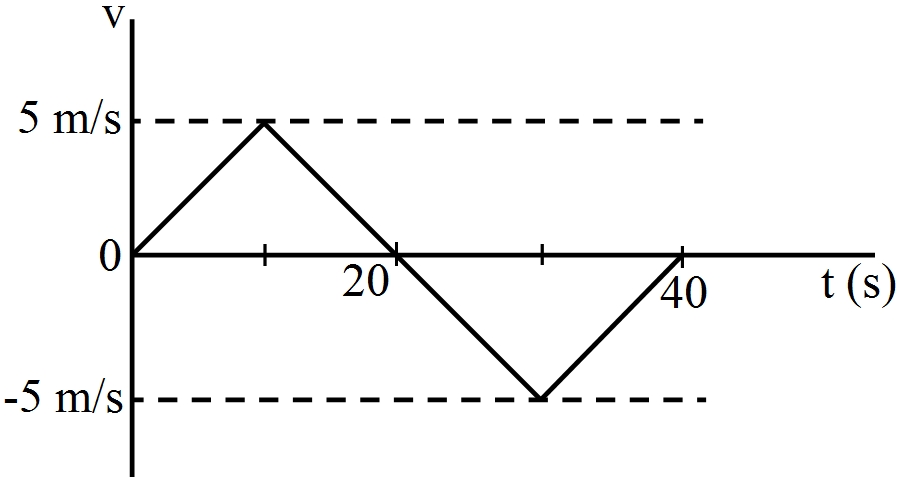
From the velocity-time plot shown in figure, find the distance travelled by the particle during the first 40 seconds. Also find the average velocity during this period.
A bird is tossing (flying to and fro) between two cars moving towards each other on a straight road. One car has a speed of 18m/h while the other has the speed of 27km/h. The bird starts moving from first car towards the other and is moving with the speed of 36km/h and when the two cars were separted by 36km. What is the total distance covered by the bird? What is the total displacement of the bird?
If the co-efficient of performance of a refrigerator is 5 and operates at the room temperature (27°C), find the temperature inside the refrigerator.
Find the electric force between two protons separated by a distance of $1$ fermi $(1 fermi = 10^{-15}m)$. The protons in a nucleus remain at a separation of this order.
The time of flight of projectile is related to its horizontal range as gT2 = 2R. Find the value of its angle of projection
A spectroscopic instrument can resolve two nearby wavelengths $\lambda$ and $\lambda+\Delta\lambda$ if $\frac{\lambda}{\Delta\lambda}$ is smaller than 8000. This is used to study the spectral lines of the Balmer series of hydrogen. Approximately how many lines will be resolved by the instrument?
A monkey climbs up a slippery pole for 3 seconds and subsequently slips for 3 seconds. Its velocity at time t is given by v(t) = 2t(3 - t); 0 < t < 3 and v(t) = -(t - 3)(6 - t) for 3 < t < 6s in m/s. It repeats this cycle till it reaches the height of 20m. At what time is its velocity maximum?
Calculate the torque on the square plate of the previous problem if it rotates about a diagonal with the same angular acceleration.
When a nucleus at rest emits a beta particle, it is found that the velocities of the recoiling nucleus and the beta particle are not along the same straight line. How can this be possible in view of the principle of conservation of momentum?
Can a vector have zero component along a line and still have nonzero magnitude?