MCQ
When the velocity of an electron increases, its de Broglie wavelength:
- AIncreases
- BDecreases
- CRemains same
- DMay increase or decrease
Generate a complete, print-ready paper with questions like this in minutes — across 16+ boards, with answer keys.
In Fresnel’s biprism experiment, on increasing the prism angle, fringe width will
|
(a) Increase |
(b) Decrease |
|
(c) Remain unchanged |
(d) Depend on the position of object |
The specific charge of an electron is
|
(a) 1.6 |
(b) 4.8 |
|
(c) 1.76 |
(d) 1.76 |
A plane mirror produces a magnification of
| (a) -1 | (b) +1 | (c) Zero | (d) Between 0 and +∞ |
Assertion : In Hertz experiment, the electric vector of radiation produced by the source gap is parallel to the gap.
Reason : Production of sparks between the detector gap is maximum when it is placed perpendicular to the source gap.
|
(a) If both assertion and reason are true and the reason is the correct explanation of the assertion. |
|
(b) If both assertion and reason are true but reason is not the correct explanation of the assertion. |
|
(c) If assertion is true but reason is false. |
|
(d) If the assertion and reason both are false. |
At neutral temperature, the thermoelectric power  has the value
|
(a) Zero |
(b) Maximum but negative |
|
(c) Maximum but positive |
(d) Minimum but positive |
A magnet NS is suspended from a spring and while it oscillates, the magnet moves in and out of the coil C. The coil is connected to a galvanometer G. Then as the magnet oscillates,
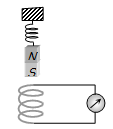
|
(a) G shows deflection to the left and right with constant amplitude |
|
(b) G shows deflection on one side |
|
(c) G shows no deflection. |
|
(d) G shows deflection to the left and right but the amplitude steadily decreases. |



