When there is an electric current through a conducting wire along its length, then an electric field must exist
Easy


Download our appand get started for free
Experience the future of education. Simply download our apps or reach out to us for more information. Let's shape the future of learning together!No signup needed.*
Similar Questions
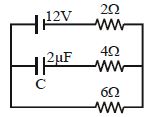
- 1Charge on the capacitor in the given circuit in steady state condition is :- ............... $\mu C$View Solution
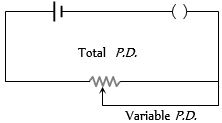
- 2View SolutionThe arrangement as shown in figure is called as
- 3Two wires of same material have length $L$ and $2L $ and cross-sectional areas $4A$ and $A$ respectively. The ratio of their specific resistance would beView Solution
- 4$10$ wires (same length, same area, same material) are connected in parallel and each has $1$ $\Omega$ resistance, then the equivalent resistance will be .............. $\Omega$View Solution
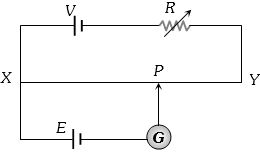
- 5A potentiometer circuit shown in the figure is set up to measure $e.m.f.$ of a cell $E$. As the point $P$ moves from $X$ to $Y$ the galvanometer $G$ shows deflection always in one direction, but the deflection decreases continuously until $Y$ is reached. In order to obtain balance point between $X$ and $Y$ it is necessary toView Solution
- 6In the circuit shown, the reading of the Ammeter is doubled after the switch is closed. Each resistor has a resistance $1\,\Omega$ and the ideal cell has an $e.m.f.$ $10\,V$. Then, the Ammeter has a coil resistance equal to ............ $\Omega$View Solution
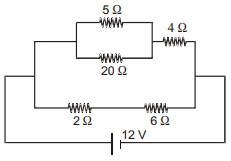
- 7A circuit containing five resistors is connected to a battery with a $12 \,V$ emf as shown in figure. The potential difference across $4 \,\Omega$ resistor is ........... $V$View Solution
- 8A $25\, W$, $ 220\, V$ bulb and a $100\, W$, $220\, V$ bulb are connected in parallel across a $440\, V$ lineView Solution
- 9View SolutionWhich of the following will NOT be observed when a multimeter (operating in resistance measuring mode) probes connected across a component, are just reversed?
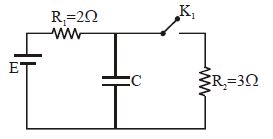
- 10In the circuit shown in the figure $K_1$ is open. The charge on capacitor $C$ in steady state is $q_1$. Now key is closed and at steady state charge on $C$ is $q_2$. The ratio of charges $q_1/q_2$ isView Solution