MCQ
When there is an electric current through a conducting wire along its length, then an electric field must exist
  • A
     Outside the wire but normal to it
  • B
     Outside the wire but parallel to it
  •  Inside the wire but parallel to it
  • D
    Inside the wire but normal to it

Answer

Correct option: C.
 Inside the wire but parallel to it
 Inside the wire but parallel to it

Need a full question paper?

Generate a complete, print-ready paper with questions like this in minutes — across 16+ boards, with answer keys.

Start Generating Free

Similar questions

An electron enters a region where magnetic $(B)$ and electric $(E)$ fields are mutually perpendicular to one another, then
Decay constant of radium is $\lambda $. By a suitable process its compound radium bromide is obtained. The decay constant of radium bromide will be
A metal conductor of length $1\;m$ rotates vertically about one of its ends at angular velocity $5$ radians per second. If the horizontal component of earth's magnetic field is $0.2 \times {10^{ - 4}}\;T$, then the $e.m.f$. developed between the two ends of the conductor is
A proton enters a magnetic field of flux density 1.5 weber/m$^2$  with a velocity of $2\times 10^7$ m/sec  at an angle of 30° with the field. The force on the proton will be
Point charge ${q_1} = 2\,\mu C$ and ${q_2} = - 1\,\mu C$ are kept at points $x = 0$ and $x = 6$ respectively. Electrical potential will be zero at points
In radio theraphy, X-rays are used to
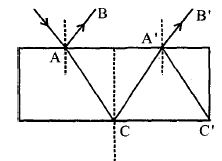
A ray of light of intensity $I$ is incident on a parallel glass slab at point $A$ as shown in diagram. It undergoes partial reflection and refraction. At each reflection, $25\%$ of incident energy is reflected. The rays $AB$ and $A'B'$ undergo interference. The ratio of $I_{max}$ and $I_{min}$ is
A choke coil is preferred to a $( Rheostat ) $ in $ ac $ circuit as
Two long and parallel wires are at a distance of 0.1 m and a current of 5 A is flowing in each of these wires. The force per unit length due to these wires will be
In a certain region of space, the potential is given by : $V = k[2x^2 - y^2 + z^2].$ The electric field at the point $(1, 1, 1) $ has magnitude =