MCQ
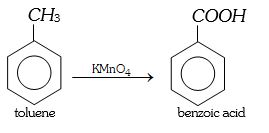
When toluene is treated with $KMn{O_4}$, what is produced
- ABenzene
- BChlorobenzene
- CBenzaldehyde
- ✓Benzoic acid
Generate a complete, print-ready paper with questions like this in minutes — across 16+ boards, with answer keys.
$C(g) + 4H(g) \to C{H_4}(g),\,\Delta H = - {x_1}\,k\,cal$
$C{H_4}(g) \to C{H_3}(g) + H(g),\,\Delta H = + y\,k\,cal$
The bond energy of $C - H$ bond is
$6 \mathrm{OH}^{-}+\mathrm{Cl}^{-} \rightarrow \mathrm{ClO}_{3}^{-}+3 \mathrm{H}_{2} \mathrm{O}+6 \mathrm{e}^{-}$
A current of $x A$ has to be passed for $10 h$ to produce $10.0 \mathrm{~g}$ of potassium chlorate. The value of $\mathrm{x}$ is $.......$ (Nearest integer)
(Molar mass of $\left.\mathrm{KClO}_{3}=122.6 \mathrm{~g} \mathrm{~mol}^{-1}, \mathrm{~F}=96500 \mathrm{C}\right)$
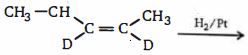
Reason : $1-$ Butene is more stable than $2-$ butene According to Saytzeff's rule, $2-$ butene should be the product which is more branched or substituted compound and hence, more stable than butene $-1$