Question
✓
Answer
COMING SOON
Need a full question paper?
Generate a complete, print-ready paper with questions like this in minutes — across 16+ boards, with answer keys.
Explore more
Similar questions

i. Which of the compounds $\mathrm{P}, \mathrm{Q}, \mathrm{R}, \mathrm{S}, \mathrm{T}, \mathrm{U}$ belong to same homologous series?
ii. Write the name of compound R. Also write the functional group present in it.
iii. What is the IUPAC name of compound T and U
OR
What are unsaturated hydrocarbons? Which of the compounds $\mathrm{P}, \mathrm{Q}, \mathrm{R}, \mathrm{S}, \mathrm{T}, \mathrm{U}$ are example of unsaturated hydrocarbons?
Read the following and answer any three questions from (i) to (iv).
The compounds which have the same molecular formula but differ from each other in physical or chemical properties are called isomers and the phenomenon is called isomerism. When the isomerism is due to difference in the arrangement of atoms within the molecule, without any reference to space, the phenomenon is called structural isomerism. ln other words, structural isomers are compounds that have the same molecular formula but different structural formulas, i.e., they are different in the order in which different atoms are linked. In these compounds, carbon atoms can be linked together in the form of straight chains, branched chains or even rings.
i. Which sets of compounds have same molecular formula?
ii. How many an organic compound is their, In order to form branching?
iii. what is an isomers?
OR
A)Name three different types of chain?
B)The number of isomers of pentane are?
Madhav took 10 g of a green salt powder in a covered beaker.
He heated the beaker for 15 minutes.
Madhav noticed that the salt powder turned whitish after 15 minutes.
He also found some droplets on the inner surface of the beaker cover.
He heated the beaker for 15 minutes.
Madhav noticed that the salt powder turned whitish after 15 minutes.
He also found some droplets on the inner surface of the beaker cover.
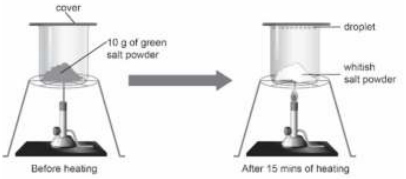
Madhav added a few drops of water to the whitish powder.
The powder turned green.
6. What can be concluded about the green salt powder from Madhav’s activity?
Circle ‘Yes’ or ‘No’ to mark your responses.
Is the reason correct? | Yes or No |
It contains moisture. | Yes/No |
It changes colour on heating. | Yes/No |
It changes to a new chemical on heating. | Yes/No |
7. Madhav repeated the same activity but kept the beaker uncovered.
Will the results remain the same? Explain your answer.
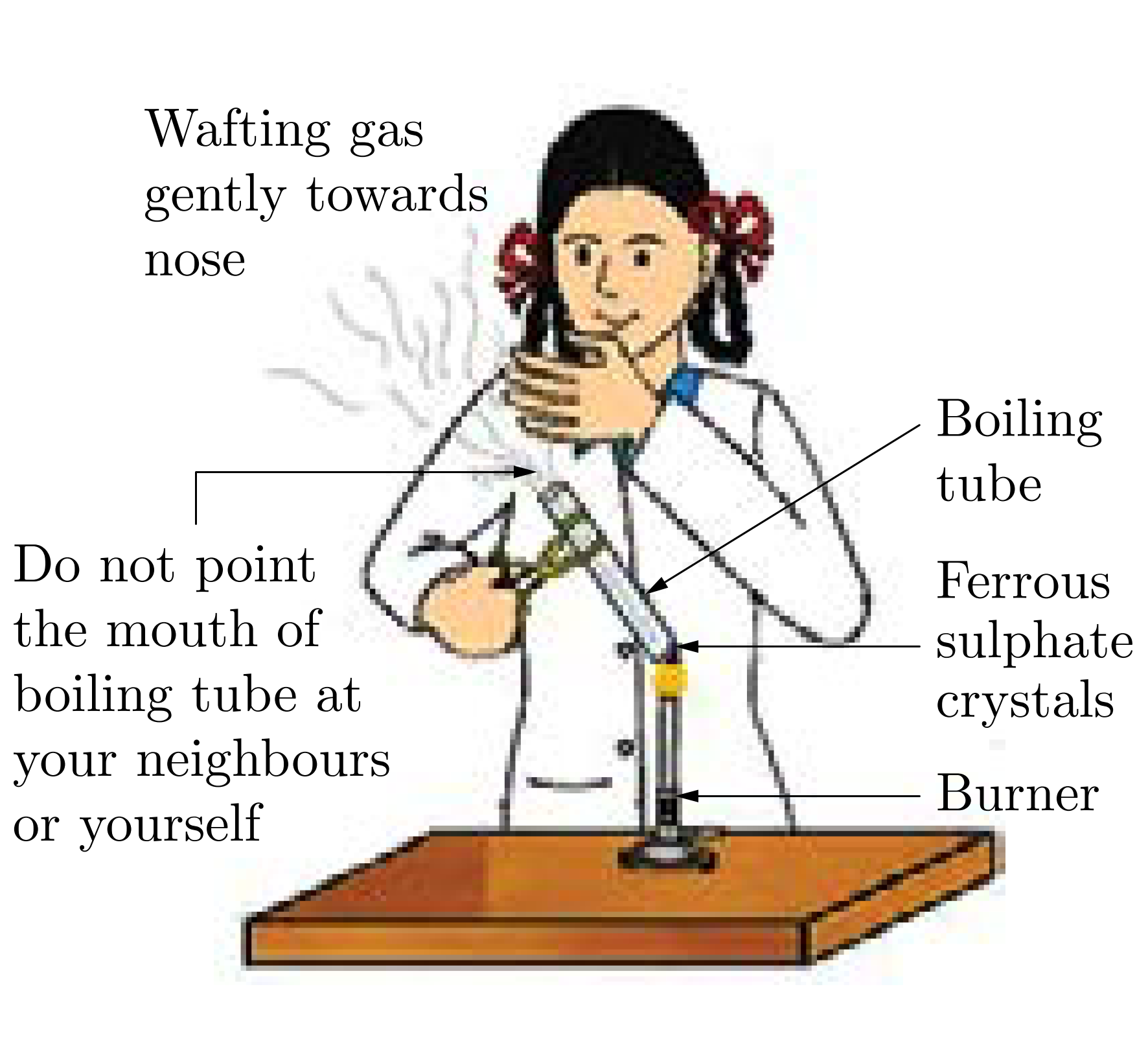
A student prepared oxygen in a lab by catalytic decomposition of potassium chlorate $\left( KClO _3\right)$ as shown in the figure. Decomposition of potassium chlorate gives potassium chloride $( KCl )$ and oxygen $\left( O _2\right)$. The following reaction takes place :
\[KClO _3( s ) \longrightarrow KCl ( s )+ O _2( g )\]
→\[KClO _3( s ) \longrightarrow KCl ( s )+ O _2( g )\]
- How many moles of $KClO _3$ are required to produce $2.4$ moles of $O _2$ ?
- Name the element which is reduced in the given reaction.
- How many moles of $KClO _3$ give 3 moles of oxygen?
or
What is the oxidation state of chlorine in potassium chlorate?
A pH paper changes its colour depending on the pH value of the substance it is dipped in.
The picture shows the different colours of a pH paper.
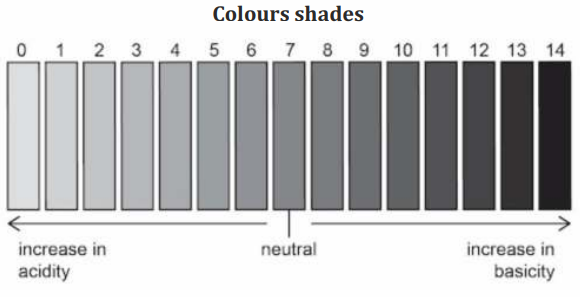
Leena tested the pH value of four liquids using a pH paper.
The table shows the shade of the pH paper after it is dipped separately in the four liquids.
1. Which liquid has the lowest concentration of hydrogen ions?
A. Liquid 1
B. Liquid 2
C. Liquid 3
D. Liquid 4
2. Leena was advised by her teacher to wear gloves and use forceps while dipping the pH paper in the liquids.
What was the reason for this advice?
Circle ‘Yes’ or ‘No’ to mark your responses.
3. What should be the colour of a pH paper after it is dipped in distilled water?
Explain your answer.
The picture shows the different colours of a pH paper.
Leena tested the pH value of four liquids using a pH paper.
The table shows the shade of the pH paper after it is dipped separately in the four liquids.
| Liquid 1 | Liquid 2 | Liquid 3 | Liquid 4 | |
| Shade of the pH paper | Colour 9 | Colour 12 | Colour 5 | Colour 3 |
A. Liquid 1
B. Liquid 2
C. Liquid 3
D. Liquid 4
2. Leena was advised by her teacher to wear gloves and use forceps while dipping the pH paper in the liquids.
What was the reason for this advice?
Circle ‘Yes’ or ‘No’ to mark your responses.
| Is the reason correct? | Yes or No |
| Gloves keep the hands warm. | Yes/No |
| Forceps provide better grip than bare hands. | Yes/No |
| Gloves protect hands from corrosive liquids. | Yes/No |
Explain your answer.
Those reactions in which two compounds react by an exchange of ions to form two new compounds are called double displacement reactions. A double displacement reaction usually occurs in solution and one of the products, being insoluble, precipitate out (separates as a solid). Any reaction in which an insoluble solid (called precipitate) is formed that separates from the solution is called a precipitation reaction. The reaction in which acid or acidic oxide reacts with base or basic oxide to form salt and water is called neutralisation reaction. For example, $2 \mathrm{NaOH}+\mathrm{H}_{2} \mathrm{SO}_{4} \longrightarrow \mathrm{Na}_{2} \mathrm{SO}_{4}+\mathrm{H}_{2} \mathrm{O}$
i. When hydrogen sulphide gas is passed through a blue solution of copper sulphate, a black precipitate of copper sulphide is obtained and the sulphuric acid so formed remains in the solution. Mention the type of reaction.
ii. Balance the following chemical reaction.
$\mathrm{Pb}\left(\mathrm{NO}_{3}\right)_{2(\mathrm{aq})}+\mathrm{KI}_{(\mathrm{aq})} \longrightarrow \mathrm{PbI}_{2(\mathrm{~s})}+\mathrm{KNO}_{3(\mathrm{aq})}$
iii. Barium chloride in reaction with ammonium sulphate forms barium sulphate and ammonium chloride. Which type of chemical reaction represents in this reaction?
OR
Identify A in the following reaction.
$\mathrm{AlCl}_{3(\mathrm{aq})}+3 \mathrm{NH}_{4} \mathrm{OH}_{(\mathrm{aq})} \longrightarrow \mathrm{A}+3\mathrm{NH}_{4} \mathrm{Cl}_{(\mathrm{aq})}$
→i. When hydrogen sulphide gas is passed through a blue solution of copper sulphate, a black precipitate of copper sulphide is obtained and the sulphuric acid so formed remains in the solution. Mention the type of reaction.
ii. Balance the following chemical reaction.
$\mathrm{Pb}\left(\mathrm{NO}_{3}\right)_{2(\mathrm{aq})}+\mathrm{KI}_{(\mathrm{aq})} \longrightarrow \mathrm{PbI}_{2(\mathrm{~s})}+\mathrm{KNO}_{3(\mathrm{aq})}$
iii. Barium chloride in reaction with ammonium sulphate forms barium sulphate and ammonium chloride. Which type of chemical reaction represents in this reaction?
OR
Identify A in the following reaction.
$\mathrm{AlCl}_{3(\mathrm{aq})}+3 \mathrm{NH}_{4} \mathrm{OH}_{(\mathrm{aq})} \longrightarrow \mathrm{A}+3\mathrm{NH}_{4} \mathrm{Cl}_{(\mathrm{aq})}$
Activity series : Relative reactivities of metals
(i) What happens when iron nail is added to copper sulphate solution? What is the colour change ?
(ii) Identify the metal which reacts with very dilute nitric acid to evolve hydrogen gas. Name one more metal not given in the above series which reacts in the same way with dilute nitric acid.
(iii) Name one important ore of copper with its chemical formula.
(iv) Which method is used to extract sodium from molten sodium chloride ?
or
(v) Which metal is used in the galvanization of iron?
| Potassium | Most reactive |
| Sodium | |
| Calcium | |
| Magnesium | |
| Aluminium | |
| Zinc | Reactivity decreases |
| Iron | |
| Lead | |
| Hydrogen | |
| Copper | |
| Mercury | |
| Silver | |
| Gold | Least reactive |
(ii) Identify the metal which reacts with very dilute nitric acid to evolve hydrogen gas. Name one more metal not given in the above series which reacts in the same way with dilute nitric acid.
(iii) Name one important ore of copper with its chemical formula.
(iv) Which method is used to extract sodium from molten sodium chloride ?
or
(v) Which metal is used in the galvanization of iron?
Read the following and answer any three questions from (i) to (iv).
A series of organic compounds having same functional group, with similar or almost identical chemical characteristics in which all the members can be represented by the same general formula and the two consecutive members of the series differ by-CH2 group or 14 mass unit in their molecular formulae is called a homologous series. For example, all the members of alcohol family can be represented by the general formula, CnH2n+1OH where, n may have the values 1, 2, 3, etc. The various members of a particular homologous series are called homologous. The physical properties such as density, melting point, boiling point, solubility, etc. of the members of a homologous series show almost regular variation in ascending or descending the series.
- What are the characteristic of members of a homologous series?
- Write the general formula of all the members of homologous series of alkynes.
- What is a homologous series? Write example.
OR - What are the 3 types of homologous series and define each.