Question
When two or more substances react and form some new substance, it is called a chemical reaction. Chemical equation is represented in terms of symbols, molecular formulas, moles, states, etc. As we know, all chemical reaction obeys law of chemical combination. Therefore, chemical reactions need to be balanced. It is done by hit and trial method. The chemical reactions can be classified into different types such as combination reaction, decomposition reaction, displacement reaction, double displacement reaction. The reactions take place in solution is precipitation reactions and neutralisation reactions.
(i) Define a chemical equation.
(ii) Which law is followed by all chemical reactions?
(iii) Name four types of chemical reactions.
or
(iv) Give example of precipitation reactions.
Answer

COMING SOON

Need a full question paper?

Generate a complete, print-ready paper with questions like this in minutes — across 16+ boards, with answer keys.

Start Generating Free

Similar questions

The growing size of the human population is a cause of concern for all people. The rate of birth and death in a given population will determine its size. Reproduction is the process by which organisms increase their population. The process of sexual maturation for reproduction is gradual and takes place while general body growth is still going on. Some degree of sexual maturation does not necessarily mean that the mind or body is ready for sexual acts or for having and bringing up children. Various contraceptive devices are being used by human beings to control the size of population.
(i) List two common signs of sexual maturation in boys and girls.
(ii) What is the result of reckless female foeticide ?
(iii) Which contraceptive method changes the hormonal balance of the body ?
or
(iv) Write two factors that determine the size of a population.
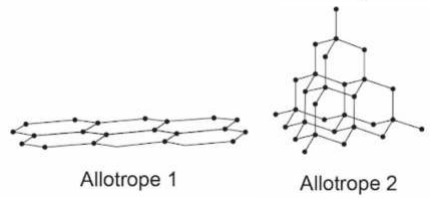
The picture shows the bonds between atoms in two allotropes of carbon.

Image
10. Which allotrope is harder? Explain your answer.

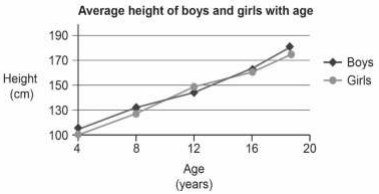
The graph shows the average height of boys and girls in a population.

Image
6. What does the graph indicate?
A. The average height of boys is always greater than that of girls.
B. The average height of girls is greater than that of boys in adulthood.
C. The average height of girls during puberty is greater than that of boys.
D. The average heights of girls and boys are the same between 4 and 20 years.
7. A student suggested a different title for the graph - ‘Height of boys and girls from birth to adulthood’.
Is the title correct? Explain your answer.
8. Which of the following statements are correct?
Circle ‘Yes’ or ‘No’ to mark your response.

Statement

Yes or No

Hormones are released directly into the bloodstream.

Yes/No

Endocrine glands use electrical impulses.

Yes/No

Sex hormones regulate changes associated with puberty.

Yes/No

9. The cerebellum in the brain controls voluntary actions of the body.
Which of these actions is controlled by the cerebellum?
A. Beating of the heart
B. Blinking of the eyes
D. Jumping from a height
C. Watering of the mouth
10. Which of these health conditions is caused by a hormonal imbalance in the body?
A. Scurvy
B. Typhoid
C. Diabetes
D. Common cold

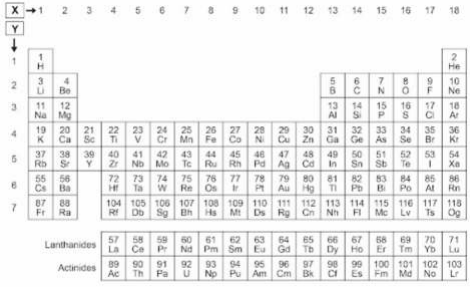
The picture shows the modern periodic table.

Image
3. What do the columns (X) and rows (Y) stand for in the periodic table?
X =
Y =
4.Which of these columns in the periodic table contains chemically inert elements?
A. X1
B. X2
C. X13
D. X18
5. What is the order of arrangement of elements in the periodic table?
A. Increase in valency
B. Decrease in atomic mass
C. Increase in atomic number
D. Decrease in the number of atomic shells
6. What does the position of an element in the periodic table indicate?
Circle ‘Yes’ or ‘No’ for the correct response.

Does the position of an element in the periodic table show this?

Yes or No

How reactive the element is?

Yes/No

What is the boiling point of the element?

Yes/No

What is the number of atomic shells in the element?

Yes/No

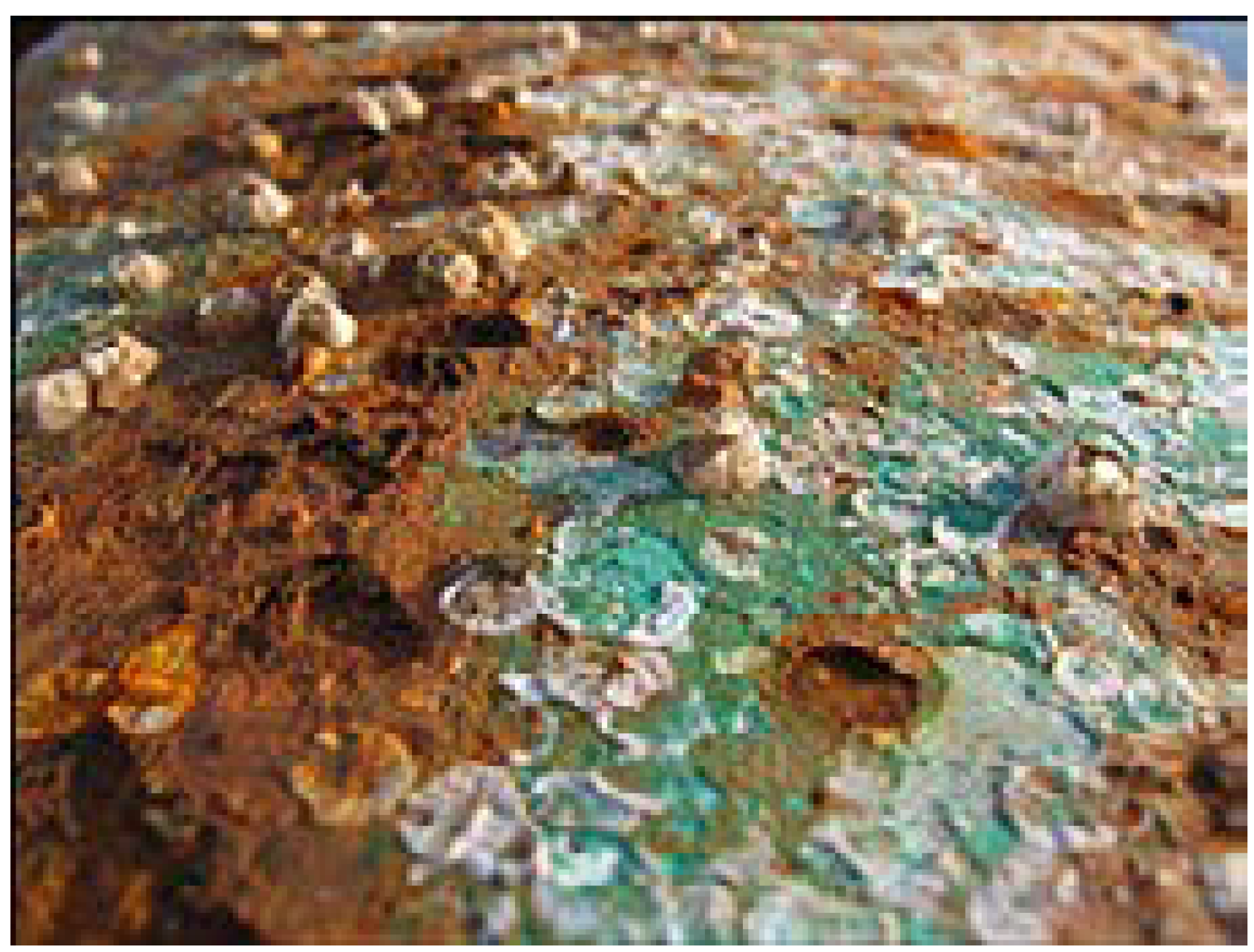
When a metal is attacked by substances around it such as moisture, acids, etc., it is said to corrode, and this process is called corrosion. The black coating on silver, green coating on copper and reddish-brown powder on iron surface are some examples of corrosion.

(i) What is the name given to the corrosion of iron?
(ii) What is the formula of green colour coating on copper?
(iii) Name two methods to prevent corrosion of iron.
or
(iv) Is corrosion a redox reaction?

Use the data in Table 12.2 to answer the following–
  1. Which among iron and mercury is a better conductor?
  2. Which matcrial is the best conductor?
Electrical resistivity of some substances at $20^oC$
- Meterial Resistivity ($\Omega$ m)
Conductors Silver $1.60 \times 10^{-8}$
Copper $1.60\times 10^{-8}$
Aluminium $2.63\times 10^{-8}$
Tungsten $5.20 \times 10^{-8}$
Nickel $6.84\times 10^{-8}$
Iron $10.0 \times 10^{-8}$
Chromoium $12.9 \times 10^{-8}$
Mercury $94.0\times 10^{-8}$
Manganese $1.84 \times 10^{-6}$
Constant (alloy of Cu, Mn and Ni) $49 \times 10^{-6}$
Alloys Manganin (alloy of Cu, Mn and Ni) $44 \times 10^{-6}$
Nichrome (alloy of Ni, Cr, MN and Fe) $100 \times 10^{-6}$
Glass $10^{10}-10^{14}$
Insulators Hard rubber $10^{13}-10^{16}$
Ebonite $10^{15}-10^{17}$
Diamond $10^{12}-10^{13}$
Paper (dry) $10^{12}$
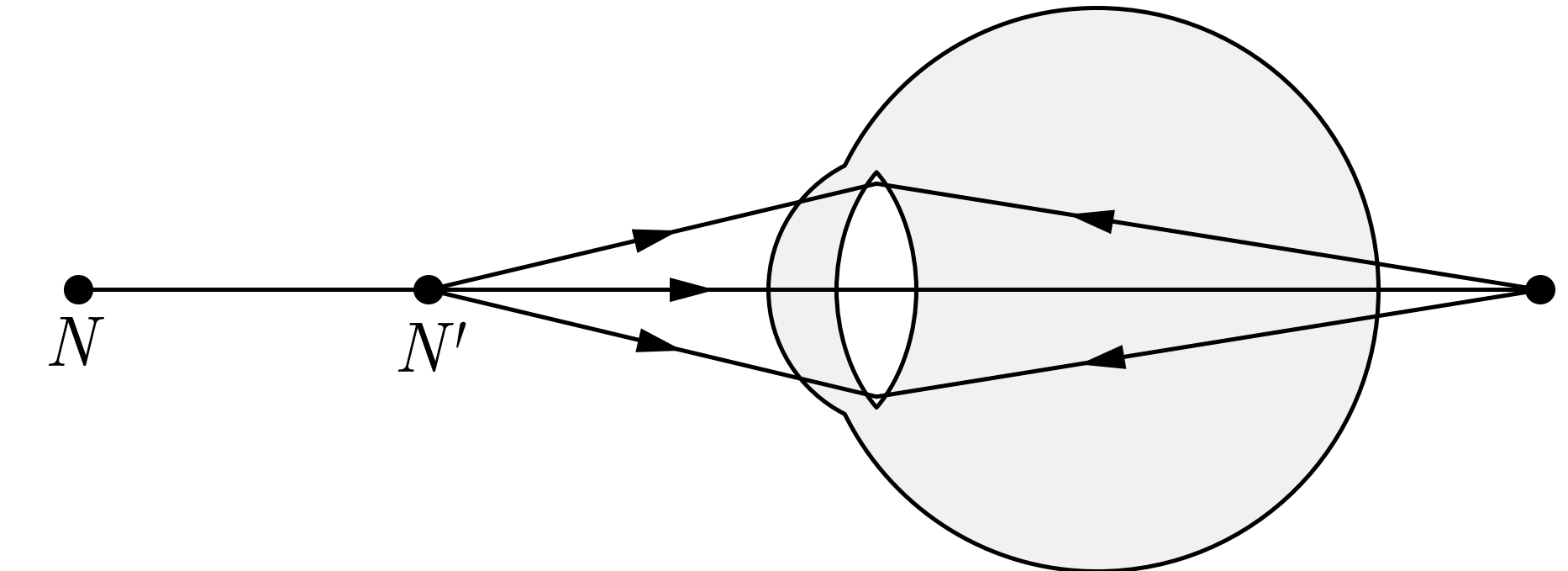
A person is suffering from hypermetropia (long sightedness). It is a defect in which a human eye can see far off object clearly, but is unable to see nearby object distinctly. The near point of the person is $1.5 m$. Assume that the near point of the normal eye is $25 cm$.

(i) What type of lens should be used in his spectacles?
(ii) What should be the focal length of the lens he used?
(iii) What will be the potver of the lens?
or
(iv) Write one possible cause of this defect.

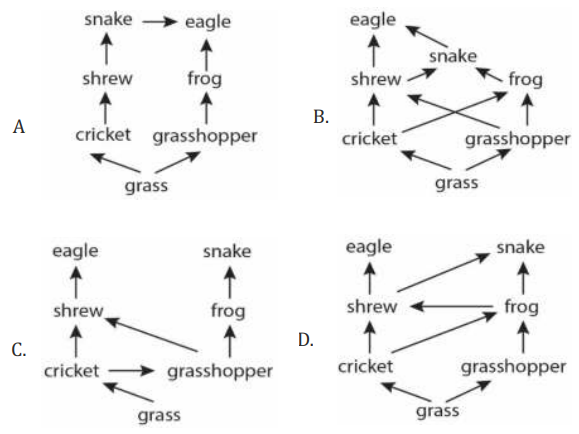
The table shows some organisms and their food sources in an ecosystem.

Organism

Food source

Frog

Cricket, Grasshopper

Cricket

Grass

Snake

Frog, Shrew

Shrew

Cricket, Grasshopper

Grasshopper

Grass

Eagle

Snake, Shrew

1. Identify the primary consumer(s) in the ecosystem.
A. Snake
B. Shrew
C. Frog and Shrew
D. Cricket and Grasshopper
2. A snake eats a frog.
What percentage of energy of the frog is transferred to the snake?
A. 1%
B. 2%
C. 10%
D. 90%
3. Which of these represents the correct food web of the ecosystem?

Image

4. Which organism has the largest biomass in the ecosystem?
A. Grass
B. Snake
C. Eagle
D. Grasshopper


Read the following and answer any four questions from (i) to (v).
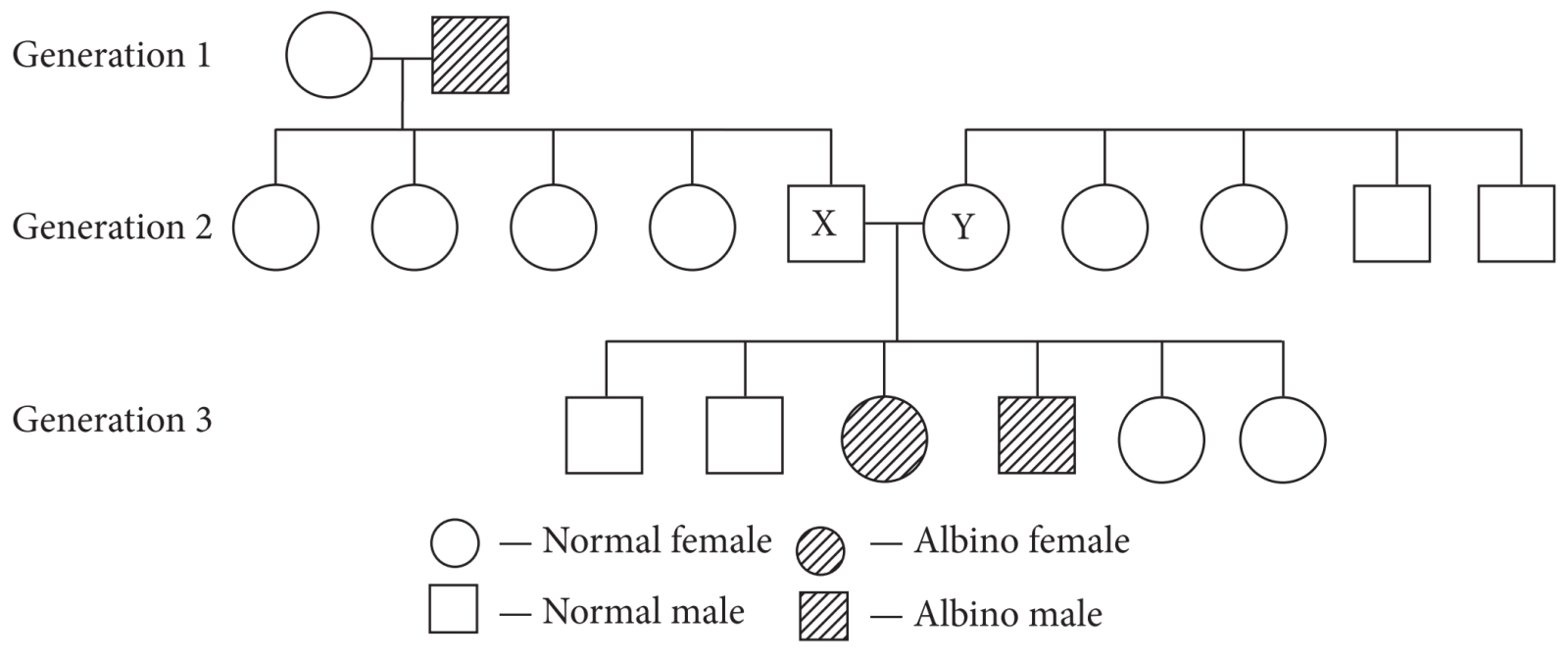
Refer to the schematic representation of the albinism that is an inherited condition caused by recessive allele (a). 'A' is the dominant allele for the normal condition. The inheritance of certain genetic traits for two or more generations is represented in a pedigree or family tree. Study the given pedigree chart and answer the following questions.
  1. Which of the following could be the genotypes of X and Y?
 
X
Y
(a)
AA
AA
(b)
AA
Aa
(c)
Aa
Aa
(d)
aa
aa
  1. Which of the following could be the genotype of generation - 1 male and female?
 
Male
Female
(a)
AA
aa
(b)
aa
AA
(c)
Aa
aa
(d)
AA
AA
  1. If X married an albino female, then what is the probability that their children would be albino?
  1. 0
  2. 0.125
  3. 0.25
  4. 0.5
  1. If Y married a normal homozygous male, then what is the probability that their children would be albino?
  1. 0
  2. 0.125
  3. 0.25
  4. 0.5
  1. Which of the following could be the genotype of offsprings produced by cross of X and Y?
  1. AA, Aa, aa
  2. aa, aa
  3. Aa, Aa
  4. AA, AA
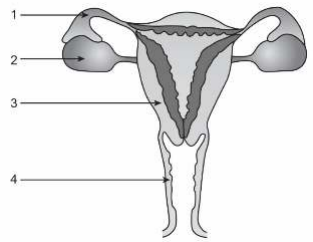
The diagram shows the reproductive system of a human female.
1, 2, 3 and 4 are four different parts of the system.

Image
8. Fertilisation is the union of a sperm with a mature egg.
In which part of the female reproductive system does fertilisation take place?
A. 1
B. 2
C. 3
D. 4
9. What is the number of sperm(s) that fertilise one egg?
10. Which of the following diseases is caused by a sexually transmissible bacterium?
A. Wart
B. Cholera
C. Inluenza
D. Gonorrhoea