Question
When two waves with same frequency and constant phase difference interfere,
  1. There is a gain of energy.
  2. There is a loss of energy
  3. The energy is redistributed and the distribution changes with time.
  4. The energy is redistributed and the distribution remains constant in time.
Answer

  1. The energy is redistributed and the distribution remains constant in time.
Explanation:
The energy is redistributed due to the presence of interference. However, as the frequency and phase remain constant. the distribution also remains constant With time.

Need a full question paper?

Generate a complete, print-ready paper with questions like this in minutes — across 16+ boards, with answer keys.

Start Generating Free

Similar questions

An electric iron draws 5 amp, a TV set draws 3 amp and refrigerator draws 2 amp from a 220 volt main line. The three appliances are connected in parallel. If all the three are operating at the same time, the fuse used may be of(a) 20 amp (b) 5 amp (c) 15 amp (d) 10 amp
       
The specific resistance of manganin is $50\times 10^{-8}\ ohm\times m.$ The resistance of a cube of length $50 \ cm $ will be
Long distance short-wave radio broadcasting uses (a) Ground wave(b) Ionospheric wave(c) Direct wave(d) Sky wave
       
Which of objective lens is used in reflector telescope :
The half-life period of radium is 1600 years. Its average life time will be(a) 3200 years(b) 4800 years(c) 2319 years(d) 4217 years
       
A movie projector forms an image $3.5m$ long of an object $35 \ mm$. Supposing there is negligible absorption of light by aperture then illuminance on slide and screen will be in the ratio of
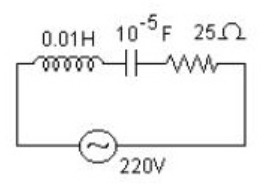
In the following circuit, the values of current flowing in the circuit at f = 0 and $\text{f}=\infty$ will respectively be.
Image
Three charges $4 q, Q$ and $q$ are in a straight line in the position of $0, I / 2$ and $I$ respectively. The resultant force on $q$ will be zero, if $Q=$
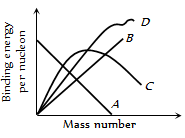
Binding energy per nucleon plot against the mass number for stable nuclei is shown in the figure. Which curve is correct
Pick the correct options.
  1. All electrons have magnetic moment.
  2. All protons have magnetic moment.
  3. All nuclei have magnetic moment.
  4. All atoms have magnetic moment.