MCQ
When vapour condenses into liquid
  • A
    It absorbs heat
  • It liberates heat
  • C
    Its temperature increases
  • D
    Its temperature decreases

Answer

Correct option: B.
It liberates heat
(b) In vapor to liquid phase transition, heat liberates.

Need a full question paper?

Generate a complete, print-ready paper with questions like this in minutes — across 16+ boards, with answer keys.

Start Generating Free

Similar questions

In a resonance pipe the first and second resonances are obtained at depths $22.7 \mathrm{~cm}$ and $70.2 \mathrm{~cm}$ respectively. What will be the end correction
Material $A$ has critical angle $i_A$, and material $B$ has critical angle $i_B\left(i_B>i_A\right)$. Then which of the following is true
(i) Light can be totally internally reflected when it passes from $B$ to $A$
(ii) Light can be totally internally reflected when it passes from $A$ to $B$
(iii) Critical angle for total internal reflection is $i_B-i_A$
(iv) Critical angle between $A$ and $B$ is $\sin ^{-1}\left(\frac{\sin i_A}{\sin i_B}\right)$
Two bodies having same mass $40 \mathrm{~kg}$ are moving in opposite directions, one with a velocity of $10 \mathrm{~m} / \mathrm{s}$ and the other with $7 \mathrm{~m} / \mathrm{s}$. If they collide and move as one body, the velocity of the combination is
A uniform chain of length $L$ and mass $M$ is lying on a smooth table and one third of its length is hanging vertically down over the edge of the table. If $g$ is acceleration due to gravity, the work required to pull the hanging part on to the table is
Three liquids of densities $d, 2 d$ and $3 d$ are mixed in equal proportions of weights. The relative density of the mixture is
Two mutually perpendicular simple harmonic vibrations have same amplitude, frequency and phase. When they superimpose, the resultant form of vibration will be
The elasticity of invar
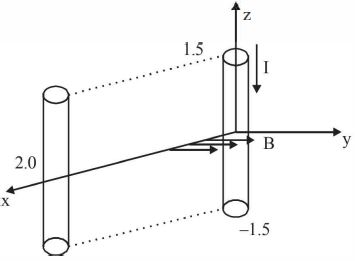
A conductor lies along the $z-$axis $a$ $-1.5$$ \le Z < 1.5\,m$ carries a fixed current of $10.0\ A$ in $ - {\hat a_z}$ direction (see figure). For a field $\vec B$ $=$ $3.0 \times  10^{-4}$  $e^{-0.2x}$ ${\hat a_y}\,T$ find the power required to move the conductor at constant speed to $x = 2.0\ m, y = 0\ m$ in $5 \times 10^{-3}\ s$. Assume parallel motion along the $x-$axis........$ W$
The type of waves that can be propagated through solid is
Which one is correct relation for thermionic emission