MCQ
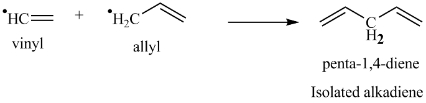
When vinyl $\&$ allyl are joined each other, we get
  • A
    Conjugated alkadiene
  • B
    comulative alkadiene
  • Isolated alkadiene
  • D
    Allenes

Answer

Correct option: C.
Isolated alkadiene
c
When vinyl and allyl are joined each other, we get penta-$1,4$-diene, which is Isolated alkadiene.

Need a full question paper?

Generate a complete, print-ready paper with questions like this in minutes — across 16+ boards, with answer keys.

Start Generating Free

Similar questions

The $IUPAC$ name of $C{H_3}C{H_2}COC{H_2}C{H_3}$ is
When a metal rod ${M}$ is dipped into an aqueous colourless concentrated solution of compound ${N}$, the solution turns light blue. Addition of aqueous $\mathrm{NaCl}$ to the blue solution gives a white precipitate ${O}$. Addition of aqueous $\mathrm{NH}_3$ dissolves ${O}$ and gives an intense blue solution.

$1.$ The metal rod ${M}$ is

$(A)$ $\mathrm{Fe}$ $(B)$ $\mathrm{Cu}$ $(C)$ $\mathrm{Ni}$ $(D)$ $\mathrm{Co}$

$2.$ The compound ${N}$ is

$(A)$ $\mathrm{AgNO}_3$ $(B)$ $\mathrm{Zn}\left(\mathrm{NO}_3\right)_2$

$(C)$ $\mathrm{Al}\left(\mathrm{NO}_3\right)_3$ $(D)$ $\mathrm{Pb}\left(\mathrm{NO}_3\right)_2$

$3.$ The final solution contains

$(A)$ $\left[\mathrm{Pb}\left(\mathrm{NH}_3\right)_4\right]^{2+}$ and $\left[\mathrm{CoCl}_4\right]^{2-}$

$(B)$ $\left[\mathrm{Al}\left(\mathrm{NH}_3\right)_4\right]^{3+}$ and $\left[\mathrm{Cu}\left(\mathrm{NH}_3\right)_4\right]^{2+}$

$(C)$ $\left[\mathrm{Ag}\left(\mathrm{NH}_3\right)_2\right]^{+}$and $\left[\mathrm{Cu}\left(\mathrm{NH}_3\right)_4\right]^{2+}$

$(D)$ $\left[\mathrm{Ag}\left(\mathrm{NH}_3\right)_2\right]^{+}$and $\left[\mathrm{Ni}\left(\mathrm{NH}_3\right)_6\right]^{2+}$

Give the answer question $1,2$ and $3.$
The main reason for larger number of oxidation states exhibited by the actinoids than the corresponding lanthanoids is
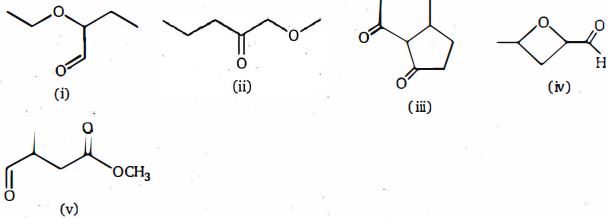
Many organic compounds contain more than one functional group. Which of the  following is both an aldehyde and an ether ?
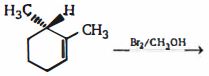
What is a likely product of the reaction shown ? 
$NaOH$ is a strong base because
Assuming complete ionisation, the $pH$ of $0.1\,M\,\,HCl$ is $1$ . The molarity of ${H_2}S{O_4}$ with the same $pH$ is
Paramagnetism is exhibited by molecules
The compound $A$ on treatment with $Na$ gives $B$, and with $\mathrm{PCl}_{5}$ gives $\mathrm{C} . \mathrm{B}$ and $\mathrm{C}$ react together to give diethyl ether. $\mathrm{A}, \mathrm{B}$ and $\mathrm{C}$ are in the order
Identify the correct reactivity order for $E_2$ reaction with alc. $KOH$