Question
When walking on ice, one should take short steps rather than long steps. Why?
Answer

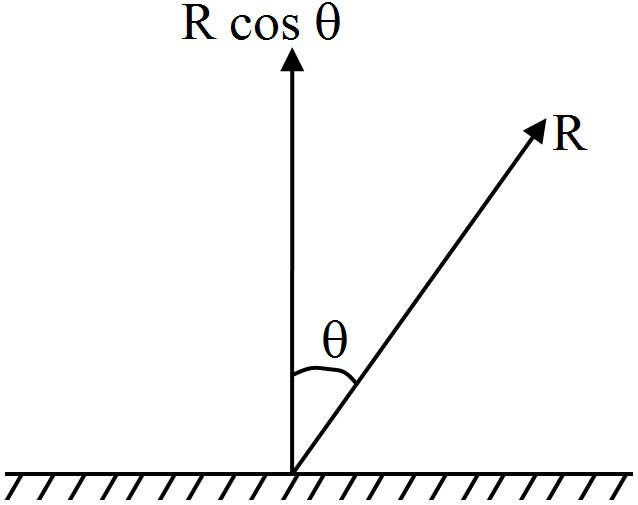
Let R represent the reaction offered by the ground. The vertical component $\text{R}\cos\theta$will balance the weight of the person and the horizontal component $\text{R}\sin\theta$ will help the person to walk forward. Now, normal reaction $=\text{R}\cos\theta$ Friction force $=\text{R}\sin\theta$ Coefficient of friction, $\mu=\frac{\text{R}\sin\theta}{\text{R}\cos\theta}=\tan\theta$ In a long step, $\theta$ is more. So tan $\theta$ is more. But µ has a fixed value. So, there is danger of slipping in a long step.

Need a full question paper?

Generate a complete, print-ready paper with questions like this in minutes — across 16+ boards, with answer keys.

Start Generating Free

Similar questions

How will you ‘weigh the sun’, that is estimate its mass? The mean orbital radius of the earth around the sun is $1.5 \times 10^8km.$
Establish a relation for the excess pressure on a drop of liquid of surface tension o, giving reason for its presence.
A body of mass $60kg$ is dragged with just enough force to start moving on a rough surface with coefficients of static and kinetic friction $0.5$ and $0.4$ respectively on applying the same force. What is the acceleration?
Does a nucleus lose mass when it suffers gamma decay?
Determine a unit vector which is perpendicular to both $\vec{\text{A}}=2\hat{\text{i}}+\hat{\text{j}}+\hat{\text{k}}$ and $\vec{\text{B}}=\hat{\text{i}}-\hat{\text{j}}+2\hat{\text{k}}.$
Two waves, travelling in the same direction through the same region, have equal frequencies, wavelengths and amplitudes. If the amplitude of each wave is 4mm and the phase difference between the waves is 90°, what is the resultant amplitude?
In a Quincke's experiment, the sound intensity has a minimum value $I$ at a particular position. As the sliding tube is pulled out by a distance of $16.5mm,$ the intensity increases to a maximum of $9I.$ Take the speed of sound in air to be $330m/s.$
  1. Find the frequency of the sound source.
  2. Find the ratio of the amplitudes of the two waves arriving at the detector assuming that it does not change much between the positions of minimum intensity and maximum intensity.
Explain the relation in phase between displacement, velocity and acceleration in S.H.M., graphically as well as theoretically.
The brass scale of a barometer gives correct reading at $0°C$. Coefficient of linear expansion of brass is $2.0 \times 10^{-5}/ ^\circ C$. The barometer reads 75.00cm at $27°C$. What is the true atmospheric pressure at $27°C$?
The moments of inertia of two rotating bodies A and B are $l_A$ and $I_B. (I_A > I_B)$ and their angular moment are equal. Which one has greater K.E.?