MCQ
When water boils or freezes, during these processes its temperature:
  • A
    Increases.
  • B
    Decreases.
  • C
    Does not change.
  • D
    Sometimes increase and sometimes deceases.

Answer

  1. Does not change.

Explanation:

When water boils or freezes, its temperature does not change during these processes. Heat here is absorbed or liberated as latent heat.

Need a full question paper?

Generate a complete, print-ready paper with questions like this in minutes — across 16+ boards, with answer keys.
Start Generating Free

Similar questions

A pendulum suspended from the ceiling of a train oscillates with a time period $2$ $second$ , when the train is accelerating at $10\,ms^{-2}$. What will be its time period when the train retards at $10\,ms^{-2}$ ? .... $s$
A ring of radius r and mass m rotates about its central axis. The kinetic energy is :
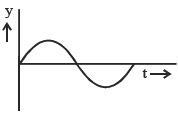
The displacement versus time graph of $SHM$ is Which of the following is its acceleration versus time graph ?
$\hat i.\left( {\hat j \times \,\,\hat k} \right) + \;\,\hat j\,.\,\left( {\hat k \times \hat i} \right) + \hat k.\left( {\hat i \times \hat j} \right)=$
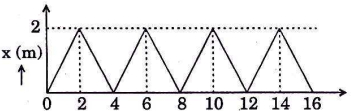
The figure shows the position - time $(x-t)$ graph of one-dimensional motion of the body of mass $0.4\; kg$. The magnitude of each impulse is 
Which of the following quantities increase when wavelength is increased? Consider only the magnitudes.
  1. The power of a converging lens.
  2. The focal length of a converging lens.
  3. The power of a diverging lens.
  4. The focal length of a diverging lens.
A boy walks uniformally along the sides of a rectangular park of size $400\, m × 300\, m$, starting from one corner to the other corner diagonally opposite. Which of the following statement is incorrect
A particle of mass Mkg describes a circle of radius 1m. The centripetal acceleration of the particle is 4m/ s2. What will be the momentum of the particle ?
In which one of the following cases will the liquid flow in a pipe be most streamlined
A perfect gas at $27°C$ is heated at constant pressure so as to triple its volume. The temperature of the gas will be ...... $^oC$