Question
When we can consider a charged particle as point electric charge ?

Answer

►When the linear size of charged bodies are much smaller than the distance separating them, the size may be ignored and the charged bodies are treated as point charges.

Need a full question paper?

Generate a complete, print-ready paper with questions like this in minutes — across 16+ boards, with answer keys.
Start Generating Free

Similar questions

a. It is not advisable to use a galvanometer as such to measure current directly. Why?
b. Why should the value of resistance connected in parallel to a galvanometer be low?
c. Is the reading shown by an ammeter in a circuit less than or more than the actual value of current flowing in the circuit? Why?
  1. Why are infra-red waves often called heat waves? Explain.
  2. What do you understand by the statement, ‘‘Electromagnetic waves transport momentum’’?
Obtain the equivalent focal length of combination of thin lenses placed in cantact.
$\left(\frac{1}{f}=\frac{1}{f_1}+\frac{1}{f_2}\right)$
A person wears glasses of power -2.5D. Is the person farsighted or nearsighted? What is the far point of the person without the glasses?
Determine the distance of closest approach when an alpha particle of kinetic energy 4·5 MeV strikes a nucleus of Z = 80, stops and reverses its direction.
  1. Monochromatic light of frequency $6.0 \times 10^{14 }Hz$ is produced by a laser. The power emitted is $2.0 \times 10^{-3} W.$ Estimate the number of photons emitted per second on an average by the source.
  1. Draw a plot showing the variation of photoelectric current versus the intensity of incident radiation on a given photosensitive surface.
A farsighted person cannot see objects placed closer to 50cm. Find the power of the lens needed to see the objects at 20cm.
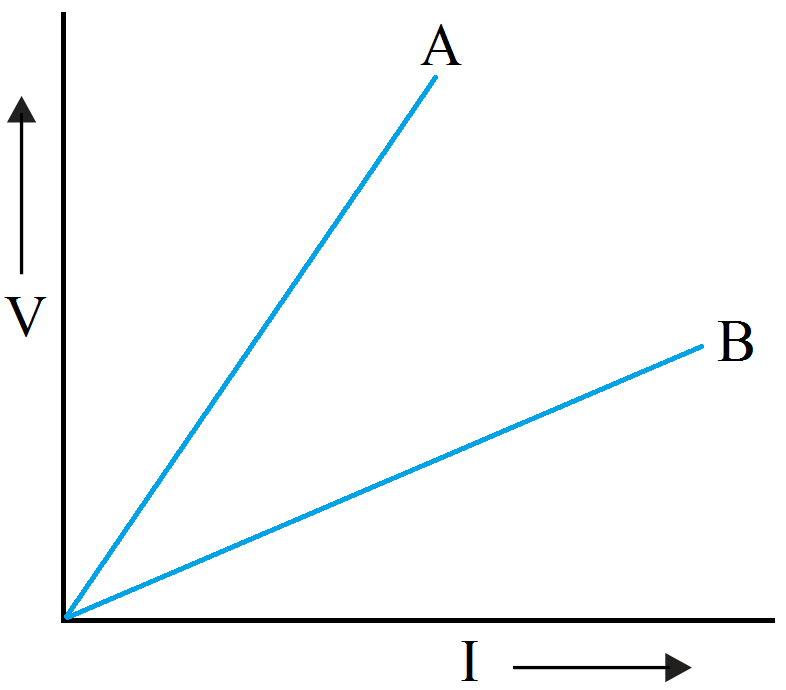
V-I graphs for parallel and series combinations of two metallic resistors are shown in figure. Which graph represents parallel combination? Justify your answer.
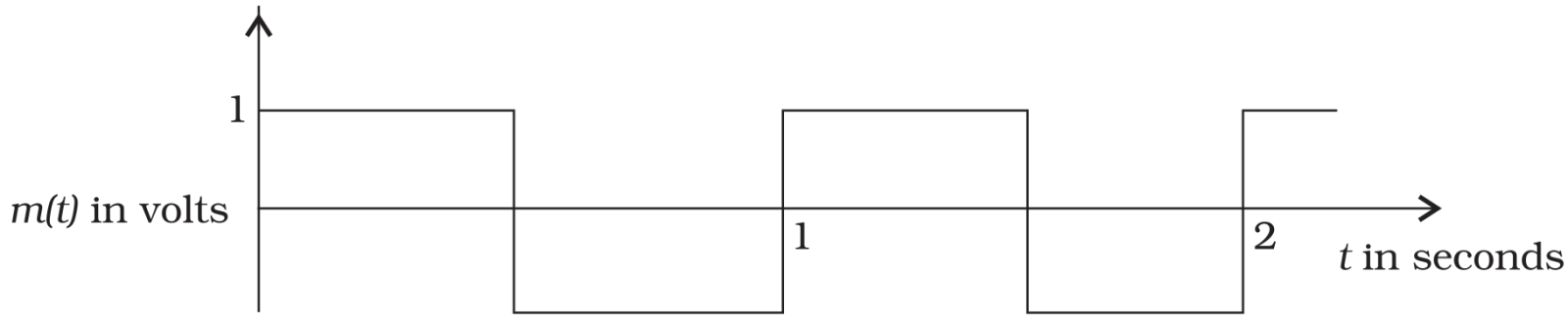
A modulating signal is a square wave, as shown in Fig.

The carrier wave is given by $c(t) = 2\sin (8\pi t)$ volts.
  1. Sketch the amplitude modulated waveform,
  2. What is the modulation index?
You are given ‘n’ resistors, each of resistance 'r'. These are first connected to get minimum possible resistance. In the second case, these are again connected differently to get maximum possible resistance. Compute the ratio between the minimum and maximum values of resistance so obtained.