Question
When we heat an object, it expands. Is work done by the object in this process ? Is heat given to the object equal to the increase in its internal energy?

Answer

When we heat an object, it expands, i.e. its volume increases.
Work done by the system, $\Delta\text{W}=\text{P}\Delta\text{V}$
Using the first law of thermodynamics, we get,
$\Delta\text{Q}=\Delta\text{U}+\Delta\text{W}$
Since the volume changes, $\Delta\text{W}$ has some non-zero positive value. Thus, heat given to the object is not equal to the increase in the internal energy of the system.

Need a full question paper?

Generate a complete, print-ready paper with questions like this in minutes — across 16+ boards, with answer keys.
Start Generating Free

Similar questions

Suppose we have 12 protons and 12 neutrons. We can assemble them to form either a :uMg nucleus or two 12C nuclei. In which of the two cases more energy will be liberated?
How does the (i) pole strength and (ii) magnetic moment of each part of a bar magnet change if it is cut into two equal pieces transverse to length?
A convex lens of focal length 20 cm is placed coaxially with a concave mirror of focal length 10 cm at a distance of 50 cm apart from each other. A beam of light coming parallel to the principal axis is incident on the convex lens. Find the position of the final image formed by this combination. Draw the ray diagram showing the formation of the image.
Find the acceleration of the moon with respect to the earth from the following data:
Distance between the earth and the moon = 3.85 × 105km and the time taken by the moon to complete one revolution around the earth = 27.3 days.
The equation of a travelling sound wave is $\text{y}=6.0\sin(600\text{t}-1.8\text{x})$ where y is measured in 10-5m, t in second and x in metre.
  1. Find the ratio of the displacement amplitude of the particles to the wavelength of the wave.
  2. Find the ratio of the velocity amplitude of the particles to the wave speed.
Explain briefly with the help of necessary diagrams, the forward and the reverse biasing of a p-n junction diode. Also draw their characteristic curves in the two cases.
A hollow charged conductor has a tiny hole cut into its surface. Show that the electric field in the hole is (σ/2ε0) $\hat{\text{n}}$ , where $\hat{\text{n}}$ is the unit vector in the outward normal direction, and σ is the surface charge density near the hole.
A charge of $20\mu\text{C}$ is placed on the positive plate of an isolated parallel-plate capacitor of capacitance $10\mu\text{F}.$ Calculate the potential difference developed between the plates.
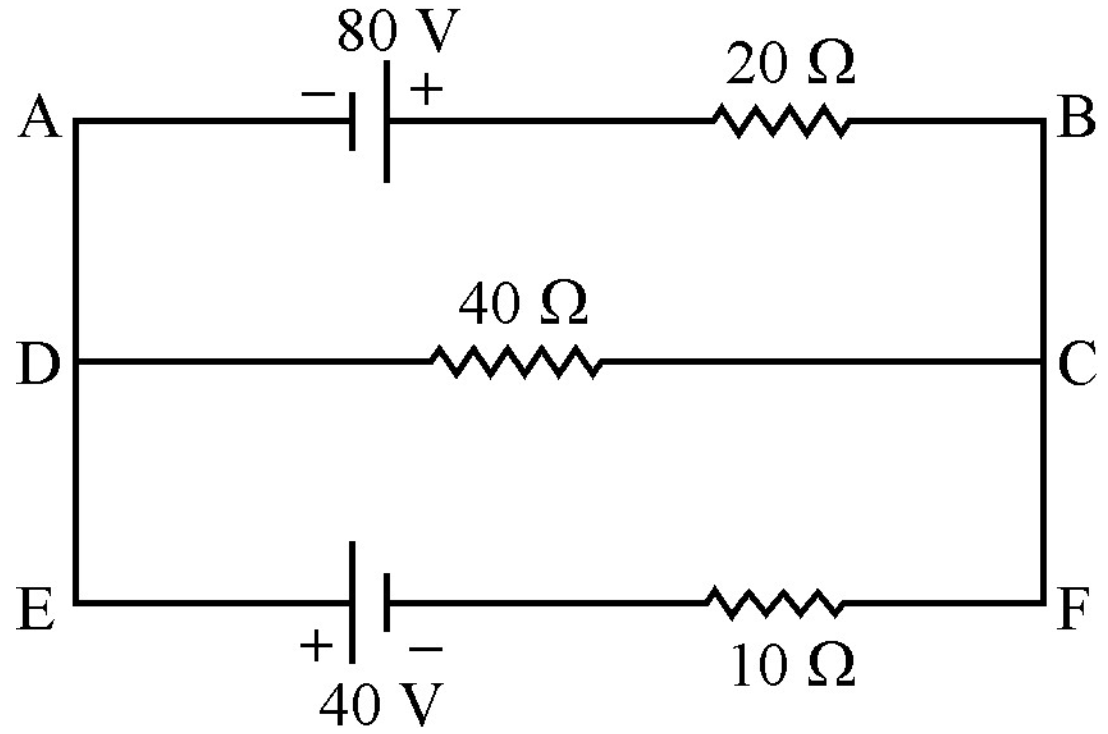
Using Kirchhoff’s rules, calculate the current through the $40\Omega$ and $20\Omega$ resistors in the following circuit:

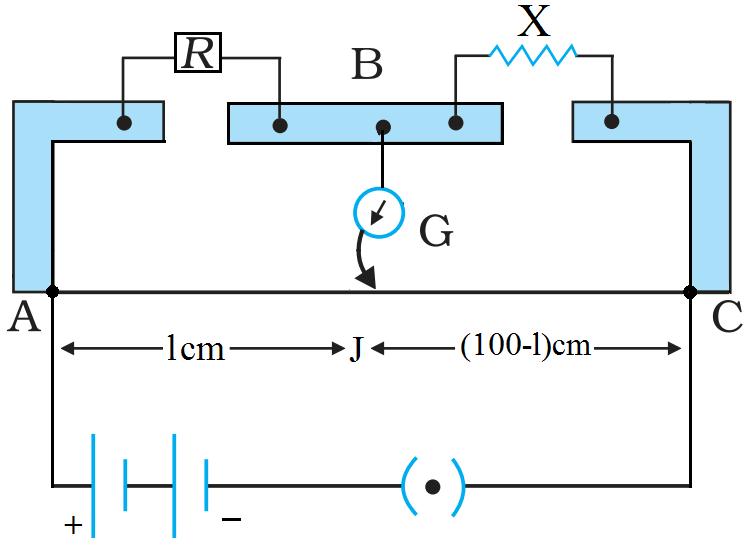
A resistance $\text{R}=4\Omega$ is connected to one of the gaps in a meter bridge, which uses a wire of length 1m. An unknown resistance $\text{x}>4\Omega$ is connected in the other gap as shown in the figure. The balance point is noticed at ‘l’ cm from the positive end of the battery. On interchanging R and X, it is found that the balance point further shifts by 20cm (away from the end A). Neglecting the end correction calculate the value of unknown resistance ‘X’ used.