Question
When we heat an object, it expands. Is work done by the object in this process ? Is heat given to the object equal to the increase in its internal energy?

Answer

When we heat an object, it expands, i.e. its volume increases. Work done by the system, $\Delta\text{W}=\text{P}\Delta\text{V}$ Using the first law of thermodynamics, we get,$\Delta\text{Q}=\Delta\text{U}+\Delta\text{W}$
Since the volume changes, $\Delta\text{W}$ has some non-zero positive value. Thus, heat given to the object is not equal to the increase in the internal energy of the system.

Need a full question paper?

Generate a complete, print-ready paper with questions like this in minutes — across 16+ boards, with answer keys.
Start Generating Free

Similar questions

It is said that any charge given to a conductor comes to its surface. Should all the protons come to the surface? Should all the electrons come to the surface? Should all the free electrons come to the surface?
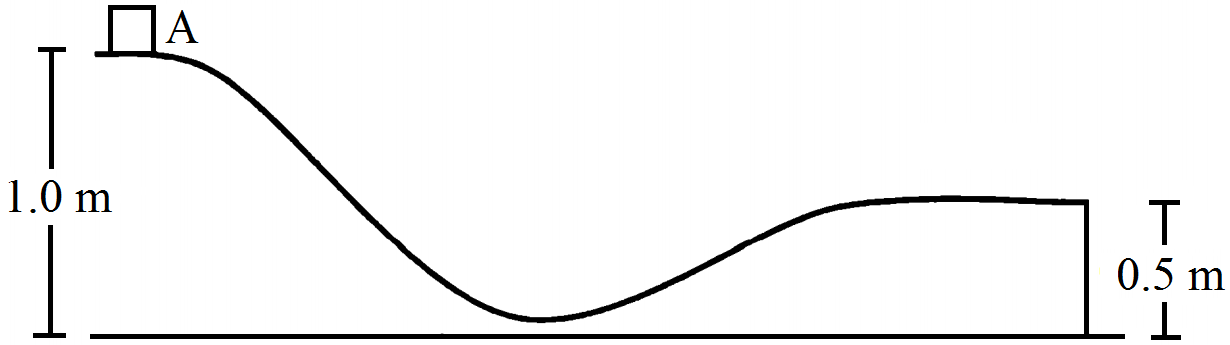
Figure shows a particle sliding on a frictionless track which terminates in a straight horizontal section. If the particle starts slipping from the point A, how far away from the track will the particle hit the ground?
The momentum p of a particle changes with time t according to the relation $\frac{\text{dp}}{\text{dt}}=(10\text{N})+(2\text{N/s)t}.$ If the momentum is zero at t = 0, what will the momentum be at t = 10s?
Light from a massive star suffers 'gravitational red shift' i.e., its wavelength changes towards the red end due to the gravitational attraction of the star. Obtain the formula for this gravitational red shift using the simple consideration that a photon of frequency v has energy $\text{h}\nu$ (h=planck's constant) and mass $\frac{\text{h}\nu}{\text{c}^2}.$ Estimate the magnitude of the red-shift for light of wavelength $5000\mathring{\text{A}}$ from a star of mass $10^{32}kg$ and radius $10^6km. G = 6.67 \times 10^{-11}Nm^2 kg^{-2}$ and $C = 3 \times 108m s^{-1}$.
Explain why: Two bodies at different temperatures $T_1$ and $T_2$ if brought in thermal contact do not necessarily settle to the mean temperature $(T_1 + T_2 )/2$.
What will be the potential energy of a body of mass $67kg$ at a distance of $6.6 \times 10^{10}m$ from the centre of the earth? Find gravitational potential at this distance.
A body starting from rest accelerates uniformly at the rate of $10 cms ^{-2}$ and retards uniform $y$ at the rate of 20 $cms ^{-2}$. Find the least time in Which it can complete the journey of 5 km if the maximum velocity attained by the body is $72 kmh ^{-1}$.
Can an electromagnetic wave be deflected by an electric field or a magnetic field?
  1. Explain the term impulse. Show that impulse of a variable force is equal to the area enclosed by the force-time curve.
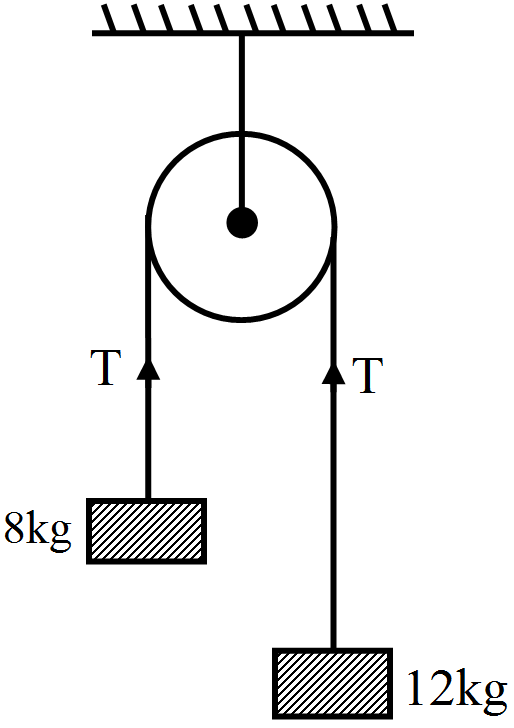
  2. Two masses $8kg$ and $12kg$ are connected at the two ends of a light inextensible string that passes over a frictionless pulley. Find the acceleration of the masses and tension in the string, when the masses are released.
Is it possible to increase the temperature of a gas without adding heat to it? Explain.