Question
When we stir a liquid vigorously, it becomes warm. Is it a reversible process?

Answer

When we stir a liquid vigorously, we do work on it due to which its temperature rises and it becomes warm. To bring back the liquid to the initial temperature, heat needs to be extracted from it. But it is an irreversible process that cannot be brought back to the initial state by stirring the liquid again in the opposite direction.

Need a full question paper?

Generate a complete, print-ready paper with questions like this in minutes — across 16+ boards, with answer keys.

Start Generating Free

Similar questions

A square coil of edge l and with n turns carries a current i. It is kept on a smooth horizontal plate. A uniform magnetic field B exists parallel to an edge. The total mass of the coil is M. What should be the minimum value of B for which the coil will start tipping over?
(i) Write the name of device 'Y' in the following given diagram
Image
(ii) Draw the circuit diagram of device 'Y'.
(iii) If the frequency of input signal is 60 Hz than what is the frequency of the output signal in a full wave rectifier?
Consider a sample of oxygen at 300K. Find the average time taken by a molecule to travel a distance equal to the diameter of the earth.
From molecular view point, discuss the temperature dependence of susceptibility for diamagnetism, paramagnetism and ferromagnetism.
Water falling from a $50m$ high fall is to be used for generating electric energy. If $1.8 \times 10^5\ kg$ of water falls per hour and half the gravitational potential energy can be converted into electric energy, how many $100W$ lamps can be lit?
  1. In a metre bridge [Fig. 3.27], the balance point is found to be at 39.5 cm from the end A, when the resistor Y is of $12.5\ \Omega.$ Determine the resistance of X. Why are the connections between resistors in a Wheatstone or meter bridge made of thick copper strips?
  2. Determine the balance point of the bridge above if X and Y are interchanged.
  3. What happens if the galvanometer and cell are interchanged at the balance point of the bridge? Would the galvanometer show any current?
You have learnt in the text how Huygens’ principle leads to the laws of reflection and refraction. Use the same principle to deduce directly that a point object placed in front of a plane mirror produces a virtual image whose distance from the mirror is equal to the object distance from the mirror.
Draw a schematic diagram of the experimental arrangement used by Davisson and Germer to establish the wave nature of electrons. Explain briefly how the de$-$Broglie relation was experimentally verified in case of electrons.
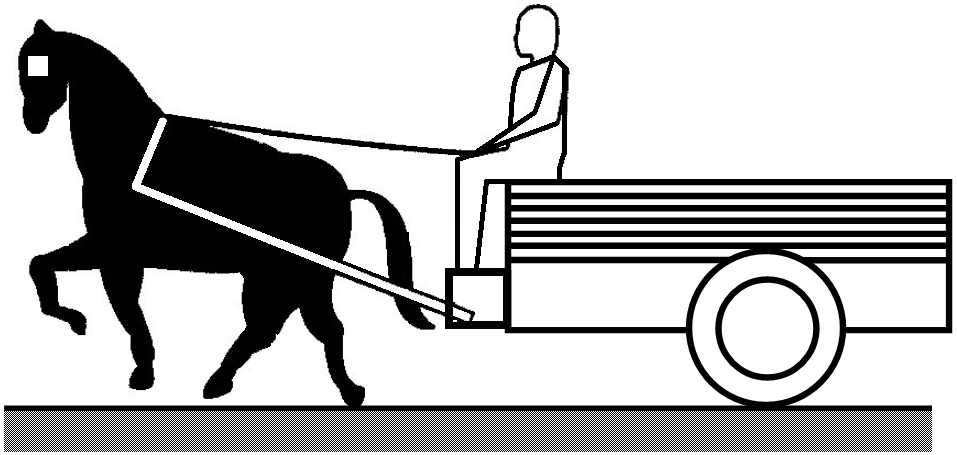
Figure shows a cart. Complete the table shown.
  1. Two cells of emf $E_1$ and $E_2$ have their internal resistances $r_1$ and $r_2$, respectively. Deduce an expression for the equivalent emf and internal resistance of their parallel combination when connected across an external resistance $R.$ Assume that the two cells are supporting each other.
  2. In case the two cells are identical, each of emf $E = 5V$ and internal resistance $\text{r}=2\Omega,$ calculate the voltage across the external resistance $\text{R}=10\Omega.$