MCQ
When X-rays, Y-rays and microwaves travel in vacuum, their :
  • A
    wavelength is equal but speed is unequal
  • B
    frequency is equal but speed is unequal
  • speed is equal but wavelength is unequal
  • D
    speed is equal and frequency is also equal

Answer

Correct option: C.
speed is equal but wavelength is unequal
C

Need a full question paper?

Generate a complete, print-ready paper with questions like this in minutes — across 16+ boards, with answer keys.
Start Generating Free

Similar questions

The rise of a liquid in a capillary tube depends on
  1. The material.
  2. The length.
  3. The outer radius.
  4. The inner radius of the tube.
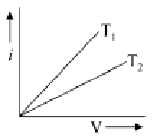
In the given figure, V-i graph of a conductor at two different temperatures is shown. If resistances corresponding to these temperatures are $R_1$ and $R _2$ respectively, then which of the following statement is correct ?
Image
The wavelength of X-rays is(a) 2000 Å(b) 2 Å(c) 1 mm(d) 1 cm
       
$E = mc^2$​​​​​​​
The work done in moving a unit positive test charge over a closed path in an electric field is _____________.
A bar magnet is released from rest along the axis of a very long, vertical copper tube. After some time the magnet:
  1. Will stop in the tube.
  2. Will move with almost content speed.
  3. Will move with an acceleration g.
  4. Will oscillate.
Which of the following radiations has the least wavelength(a) g -rays(b) b-rays(c) a-rays(d) X-rays
       
If the strength of the magnetic field produced $10\ cm$ away from a infinitely long straight conductor is $10^{-5}$ weber $/ m ^2$ , the value of the current flowing in the conductor will be
$1C$ is the charge which is placed at a distance of $1m$ from the another charge of same magnitude in vacuum experiences an electrical force of repulsion of magnitude:
Work function of a metal is 2.1 eV. Which of the waves of the following wavelengths will be able to emit photoelectrons from its surface(a) 4000 Å, 7500 Å(b) 5500 Å, 6000 Å (c) 4000 Å, 6000 Å(d) None of these