Question
When yellow light is incident on a surface, no electrons are emitted while green light can emit. If red light is incident on the surface, then(a) No electrons are emitted(b) Photons are emitted(c) Electrons of higher energy are emitted(d) Electrons of lower energy are emitted


Answer

(a) No electrons are emitted

Need a full question paper?

Generate a complete, print-ready paper with questions like this in minutes — across 16+ boards, with answer keys.

Start Generating Free

Similar questions

Out of dia, para and ferromagnetism, the universal property of all substances is:
Which of the following gives the value of magnetic field according to,  Biot$-$Savart’s law’
Assertion   :   The permeability of a ferromagnetic material is independent of the magnetic field.
Reason       : Permeability of a material is a constant quantity.(a) If both assertion and reason are true and the reason is the correct explanation of the assertion.(b) If both assertion and reason are true but reason is not the correct explanation of the assertion.(c) If assertion is true but reason is false.(d) If the assertion and reason both are false.


The similarity between the sound waves and light waves is(a) Both are electromagnetic waves(b) Both are longitudinal waves(c) Both have the same speed in a medium(d) They can produce interference


(1) The product of a volt and a coulomb is a joule.
(2)  The product of a volt and an ampere is a joule/second.
(3)  The product of volt and watt is horse power.
(4)  Watt-hour can be measured in terms of electron volt.
State if(a) All four are correct(b) (1), (2) and (4) are correct(c) (1) and (3) are correct(d) (3) and (4) are correct
   
   
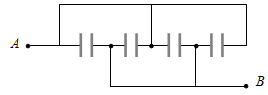
Four condensers are joined as shown in the adjoining figure. The capacity of each is $8 \mu F$. The equivalent capacity between the points $A$ and $B$ will be
A charged particle oscillates about its mean equilibrium position with a frequency of $10^9 \ Hz.$ The electromagnetic waves produced$:$
A sky wave with a frequency $55 \ \text{MHz}$ is incident on $D-$region of earth's atmosphere at $45^{\circ}$. The angle of refraction is $($electron density for $D-$region is $400$ electron $/ \mathrm{cm}^3 )$
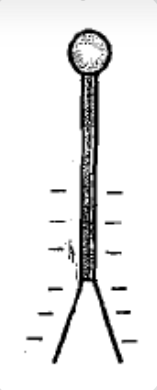
The adjoining figure shows a negatively charged electroscope. If a negatively charged rod is brought close to, but not touching, the knob, the two leaves will:
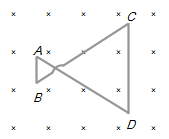
A conducting wire frame is placed in a magnetic field which is directed into the paper. The magnetic field is increasing at a constant rate. The directions of induced current in wires $AB$ and $CD$ are