MCQ
Which acid on heating produces phosphine ?
  • A
    phosphoric acid
  • phosphorous acid
  • C
    Peroxymonophosphoric acid
  • D
    metaphosphoric acid

Answer

Correct option: B.
phosphorous acid
b

Need a full question paper?

Generate a complete, print-ready paper with questions like this in minutes — across 16+ boards, with answer keys.

Start Generating Free

Similar questions

When $AgN{O_3}$ is heated strongly, the products formed are
What would be the electrode potential for the given half cell reaction at $pH = 5$ ? ........... $\mathrm{V}$

$2 \mathrm{H}_{2} \mathrm{O} \rightarrow \mathrm{O}_{2}+4 \mathrm{H}^{\oplus}+4 \mathrm{e}^{-} ; \mathrm{E}_{\mathrm{red}}^{0}=1.23 \mathrm{V}$

$(\mathrm{R}=8.314 \;\mathrm{J} \mathrm{mol}^{-1} \mathrm{K}^{-1} ; \text { Temperature }=298 \;\mathrm{K} ;$ oxygen under std. atm. pressure of $1 \;bar$)
Calculate the ${H^ + }$ ion concentration in a $1.00\,(M)$ $\,HCN\,$ litre solution $({K_a} = 4 \times {10^{ - 10}})$
One mole of each of the following alkenes is catalytically hydrogenated. The quantity of heat evolved will be the lowest in the case of
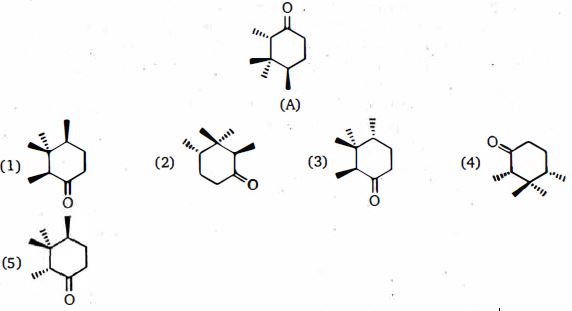
Which of the structures is/are diastereomer of $A$ ?
Isomerism in saturated hydrocarbons is due to
$20\,mL$ of $0.02\,M$ hypo solution is used for the titration of $10\,mL$ of copper sulphate solution, in the presence of excess of $KI$ using starch as an indicator. The molarity of $Cu ^{2+}$ is found to be $\times 10^{-2}\,M$[nearest integer]Given : $2 Cu ^{2+}+4 I ^{-} \rightarrow Cu _{2} I _{2}+ I _{2}$ $I _{2}+2 S _{2} O _{3}{ }^{2-} \rightarrow 2 I ^{-}+ S _{4} O _{6}{ }^{2-}$
Which of the following reaction does not give primary amine as a product ?
The colour of the $\mathrm{X}_2$ molecules of group $17$ elements changes gradually from yellow to violet down the group. This is due to

[$A$] the physical state of $\mathrm{X}_2$ at atom temperature changes from gas to solid down the group

[$B$] decrease in $HOMO-LUMO$ gap down the group

[$C$] decrease in $\pi^*-\sigma^*$ gap down the group

[$D$] decrease in ionization energy down the group

Which of the elements listed below occurs in allotropic forms