MCQ
Which amide gives bromamide reaction? propanamine by Hoffmann bromamide reaction?
- ✓Butanamide
- BEthanamide
- CPropanamide
- DPentanamide
Generate a complete, print-ready paper with questions like this in minutes — across 16+ boards, with answer keys.
$\mathrm{Zn}\left|\mathrm{Zn}^{2+}(\mathrm{aq}),(1 \mathrm{M}) \| \mathrm{Fe}^{3+}(\mathrm{aq}), \mathrm{Fe}^{2+}(\mathrm{aq})\right| \mathrm{Pt}(\mathrm{s})$
The fraction of total iron present as $\mathrm{Fe}^{3+}$ ion at the cell potential of $1.500\, \mathrm{~V}$ is $\mathrm{X} \times 10^{-2}$. The value of $x$ is $.....$ (Nearest integer).
$\left(\right.$ Given $\left.E_{\mathrm{Fe}^{3+} / \mathrm{Fe}^{2+}}^{0}=0.77\, \mathrm{~V}, \mathrm{E}_{\mathrm{Zn}^{2+} / \mathrm{Zn}}^{0}=-0.76 \,\mathrm{~V}\right)$
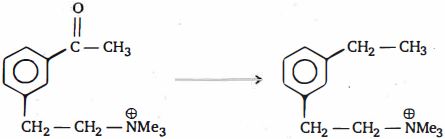
Compound $(C)$ is
Statement $I :$ The boiling points of the following hydrides of group $16$ elements increases in the order -
$H _{2} O < H _{2} S < H _{2} Se < H _{2} \text { Te. }$
Statement $II :$ The boiling points of these hydrides increase with increase in molar mass.
In the light of the above statements, choose the most appropriate answer from the options given below
$(I)\, Co(III)$ is stabilised in presence of weak field ligands, while $Co(II)$ is stabilised in presence of strong field ligand.
$(II)$ Four coordinated complexes of $Pd(II)$ and $Pt(II)$ are diamagnetic and square planar.
$(III)\,[Ni (CN)_4]^{4-}$ ion and $[Ni (CO)_4]$ are diamagnetic tetrahedral and square planar respectively.
$(IV)\,Ni^{2+}$ ion does not form inner orbital octahedral complexes.