Question
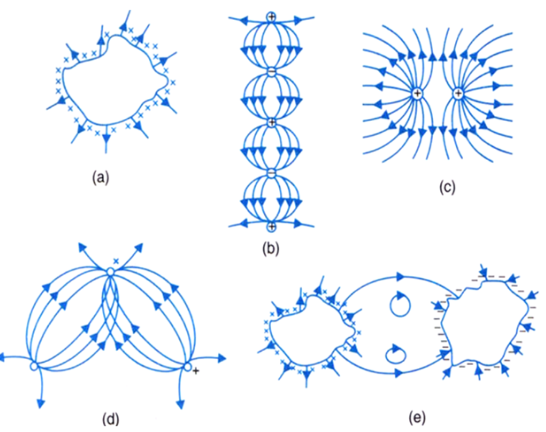
Which among the curves shown in Fig. 1.35 cannot possibly represent electrostatic field lines?

Answer

  1. Figure (a) cannot represent electrostatic field lines since electrostatic field lines start or end only at 90° to the surface of the conductor.
  2. Figure (b) too cannot represent electrostatic field lines as electrostatic field lines do not start from a negative charge. Electric field lines always traverse from a region of positive charge to a region of negative charge.
  3. Electrostatic field lines are represented by figure (c).
  4. Figure (d) cannot represent electrostatic field lines since no two such lines of force can intersect each other.
  5. As electrostatic field lines cannot form closed loop, therefore figure (d) also does not represent electrostatic field lines.

Need a full question paper?

Generate a complete, print-ready paper with questions like this in minutes — across 16+ boards, with answer keys.
Start Generating Free

Similar questions

Area of a parallel plate capacitor is A and distance between them is $d$. It is charged with a constant current of I. An element of area $\frac{A}{2}$ is kept in the middle of the plates, parallel to the plates. What is the current flowing through this area?
A wheel of mass 10kg and radius 20cm is rotating at an angular speed of 100rev/min when the motor is turned off. Neglecting the friction at the axle, calculate the force that must be applied tangentially to the wheel to bring it to rest in 10 revolutions.
A series LCR circuit with R = 20Ω, L = 1.5H and C = 35μF is connected to a variable-frequency 200V ac supply. When the frequency of the supply equals the natural frequency of the circuit, what is the average power transferred to the circuit in one complete cycle?
In a hydrogen atom, the electron and proton are bound at a distance of about 0.53 $\mathring{\text{A}}$:
  1. Estimate the potential energy of the system in eV, taking the zero of the potential energy at infinite separation of the electron from proton.
  2. What is the minimum work required to free the electron, given that its kinetic energy in the orbit is half the magnitude of potential energy obtained in (a)?
  3. What are the answers to (a) and (b) above if the zero of potential energy is taken at 1.06 Å separation?
Consider a thin target $\left(10^{-2} m\right.$ square, $10^{-3} m$ thickness $)$ of sodium, which produces a photocurrent of $100 \mu A$ when a light of intensity $100 W / m ^2(\lambda=660 nm)$ falls on it. Find the probability that a photoelectron is produced when a photon strikes a sodium atom. [Take density of $Na =0.97 kg / m ^3$ ].
Consider the situation of the previous problem. A particle having charge q and mass m is projected from the point Q in a direction going into the plane of the diagram. It is found to describe a circle of radius r between the two plates. Find the speed of the charged particle.
Three identical metal plates with large surface areas are kept parallel to each other as shown in figure. The leftmost plate is given a charge Q, the rightmost a charge -2Q and the middle one remains neutral. Find the charge appearing on the outer surface of the rightmost plate.

Write two properties and two uses of X-rays.
A capacitor of capacitance $100\mu\text{F}$ is connected to a battery of 20 volts for a long time and then disconnected from it. It is now connected across a long solenoid having 4000 turns per metre. It is found that the potential difference across the capacitor drops to 90% of its maximum value in 2.0 seconds. Estimate the average magnetic field produced at the centre of the solenofd during this period.
A proton has spin and magnetic moment just like an electron. Why then its effect is neglected in magnetism of materials?