Question
Which among the following is true about magnetic susceptibility?

Answer

  1. It is the ratio of intensity of magnetization to magnetic intensity.
Explanation:
Magnetic susceptibility of a magnetic substance is defined as the ratio of the intensity of magnetization (I) to the magnetic intensity (H). The expression is given by:
$\text{Xm}=\frac{\text{I}}{\text{H}}$
Magnetic susceptibility measures the aptness of a magnetic substance to acquire magnetism. It is a unit less constant of magnetic substance.

Need a full question paper?

Generate a complete, print-ready paper with questions like this in minutes — across 16+ boards, with answer keys.
Start Generating Free

Similar questions

Three capacitors each of capacity 4μF  are to be connected in such a way that the effective capacitance is 6 μF. This can be done by(a) Connecting them in parallel(b) Connecting two in series and one in parallel(c) Connecting two in parallel and one in series(d) Connecting all of them in series
   
   
In Thomson experiment of finding e/m for electrons, beam of electron is replaced by that of muons (particle with same charge as of electrons but mass 208 times that of electrons). No deflection condition in this case satisfied if(a) B is increased 208 times(b) E is increased 208 times(c) B is increased 14.4 times(d) None of these
   
   
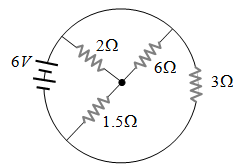
The total current supplied to the circuit by the battery is
Two magnets $A$ and $B$ are identical in mass, length and breadth but have different magnetic moments. In a vibration magnetometer, if the time period of $B$ is twice the time period of $A.$ The ratio of the magnetic moments
$\mathrm{M}_{\mathrm{A}} / \mathrm{M}_{\mathrm{B}}$ ot the magnets will be
Ratio of magnetic intensities for an axial point and a point on broad side-on position at equal distance d from the centre of magnet will be or The magnetic field at a distance d from a short bar magnet in longitudinal and transverse positions are in the ratio(a) 1 : 1(b) 2 : 3(c) 2 : 1(d) 3 : 2
       
In case of a Van de Graaff generator, the breakdown field of air is:
The tangent at any point of  field line gives the direction of:
The intrinsic semiconductor becomes an insulator at(a) 0℃(b) --100℃(c) 300 K(d) 0 K
       
An $\alpha-$particle is bombarded on $^{14}N.$ As a result $,a ^{17}O$ nucleus is formed and a particle is emitted. This particle is $a:$
If the direction of the initial velocity of a charged particle is neither along nor perpendicular to that of the magnetic field, then the orbit will be: