MCQ
Which atom can have more than eight valence electrons when it is forming covalent bonds?
  • A
    $H$
  • B
    $N$
  • C
    $F$
  • D
    $Cl$

Answer

$(d)$ Due to presence of vacant d-orbital excitation occurs in $Cl-$ atom and it  can have more than eight valence electrons when it is forming hypervalent  compound like $HClO_4$

Need a full question paper?

Generate a complete, print-ready paper with questions like this in minutes — across 16+ boards, with answer keys.

Start Generating Free

Similar questions

Among the following rules, the one which is applied in the given reaction is $CH _{3} CHBrCH _{2} CH _{3} \stackrel{ Alc.KOH }{\longrightarrow}$

$I.$ $C H_{3} C H=C H C H_{3}$ (major product)

$II.$ $C H_{2}=C H C H_{2} C H_{3}$ (minor product)

Azo isopropane decomposes according to the equation

${\left( {C{H_3}} \right)_2}CHN = NCH{\left( {C{H_3}} \right)_2}\left( g \right)\xrightarrow[{{{\text{N}}_2}{\text{(g) + }}{{\text{C}}_6}{{\text{H}}_{14}}{\text{(g)}}}]{{250 - 290{}\,^oC}}$

It is found to be a first order reaction. If initial pressure is $P_o$ and pressure of the mixture at time $t$ is $(P_t)$ then rate constant $K$ would be
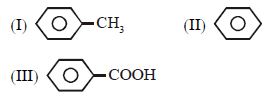
An unknown compound $(A)$ (molarmass $= 180$) on acylation gives a product  (molar mass $= 390$) than find the number of hydroxyl group present in  compound $(A)$ .
Correct order of stability is
Consider the oxides of group $14$ elements $\mathrm{SiO}_2, \mathrm{GeO}_2, \mathrm{SnO}_2, \mathrm{PbO}_2, \mathrm{CO}$ and $\mathrm{GeO}$. The amphoteric oxides are
The total number of isomers for a square planar complex $[M(F)(Cl)(SCN (NO_2)]$ is
In which of the following arrangements, the order is not correct according to the property indicated against it
Increasing order of the following for electrophile substitution reaction as
The rate of certain reaction depends on concentration according to the equation $\frac{{ - dc}}{{dt}}\, = \,\frac{{{K_1}C}}{{1 + {K_2}C}},$ what is the order, when concentration $(c)$ is very-very high
The $pH$ of a buffer solution containg $0.2$ mole per litre $C{H_3}COONa$ and $1.5$ mole per litre $C{H_3}COOH$ is ($Ka$ for acetic acid is $1.8 \times {10^{ - 5}})$