MCQ
Which bond angle $\theta $ would result in the maximum dipole moment for the triatomic molecule $YXY$
- ✓$\theta = {90^o}$
- B$\theta = {120^o}$
- C$\theta = {150^o}$
- D$\theta = {180^o}$
$\cos 90^o = 0$. Since the angle increases from $90 - 180$, the value of $\cos \theta $ becomes more and more $-ve$ and hence resultant decreases. Thus, dipole moment is maximum when $\theta = 90^o $.
Generate a complete, print-ready paper with questions like this in minutes — across 16+ boards, with answer keys.
Reason : $[Fe(CN)_6]^{3-}$ has $+3$ oxidation state while $[Fe(CN)_6]^{4-}$ has $+2$ oxidation state.
$(I)$ $\begin{array}{*{20}{c}} {C{H_3}\,\,\,\,\,\,Br} \\ {|\,\,\,\,\,\,\,\,\,\,\,\,\,\,\,\,|\,\,} \\ {C{H_3} - CH - CH - C{H_3}} \end{array}$
$(II)$ $[Figure\,2]$
$(III)$ $\begin{array}{*{20}{c}} {{C_6}{H_5} - CH - {C_6}{H_5}} \\ {|\,\,\,} \\ {Br} \end{array}$
$(IV)$ $[Figure\,4]$
Which one of the following is correct sequence of the halides given above in the decreasing order of their reactivity ?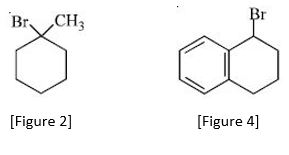
Given that $\left[ {\frac{{{{\left[ B \right]}_t}}}{{{{[C]}_t}}} = \frac{{16}}{9}} \right]$
$A\,\xrightarrow{{{K_1}\, = \,2\, \times \,{{10}^{^{ - 3}\,}}{S^{ - 1}}}}4B$
$A\to C$