MCQ
Which $C-$atoms is the most electronegative in this structure $\mathop {C{H_3}}\limits^{{\rm{III}}} - \mathop {C{H_2}}\limits^{{\rm{II}}} - C \equiv \mathop {CH}\limits^{\rm{I}} $
- ✓$I$
- B$II$
- C$III$
- DAll are equal electronegative
Elecronegativity $\propto$ $s$-character.
In $sp$ hybrid orbitals, $s$ character $=50\, \%$
and in $sp ^3$ hybrid orbitals, $s$ character $=33.3 \,\%$
Thus, option $I$ is the most electronegative.
Generate a complete, print-ready paper with questions like this in minutes — across 16+ boards, with answer keys.
$L(1s^2, 2s^2 2p^4); Q(1s^2, 2s^2 2p^6, 3s^2 3p^5)$
$P(1s^2, 2s^2 2p^6, 3s^1); R(1s^2, 2s^2 2p^6, 3s^2)$
The formulae of ionic compounds that can be formed between these elements are
(Given, $\frac{ d (\ln K )}{ d \left(\frac{1}{T}\right)}=-\frac{\Delta H^{\ominus}}{ R }$, where the equilibrium constant, $K =\frac{ p _{ z }}{ p ^{\ominus}}$ and the gas constant, $R =8.314$ $\left.J K ^{-1} mol ^{-1}\right)$
($1$) The value of standard enthalpy, $\Delta H ^{\ominus}$ (in $kJ mol ^{-1}$ ) for the reaction is. . . . . . .
($2$) The value of $\Delta S^{\ominus}$ (in $J K ^{-1} mol ^{-1}$ ) for the given reaction, at $1000 K$ is. . . . . .
Give the answer or quetin ($1$) and ($2$)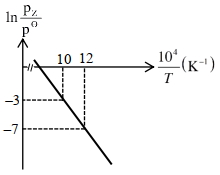
$NH _{2} CN _{( s )}+\frac{3}{2} O _{2}( g ) \rightarrow N _{2( g )}+ O _{2}( g )+ H _{2} O _{(l)}$
is ............ $kJ$. (Rounded off to the nearest integer)
[Assume ideal gases and $\left. R =8.314\, J\, mol ^{-1} K ^{-1}\right]$
$(i)\, {\Delta _f}{H^o}$ of $N_2O$ is $82\, kJ\, mol^{-1}$
$(ii)$ Bond energies of $N \equiv N,N = N,O = O$ and $N = O$ are $946, 418, 498$ and $607\, kJ\, mol^{- 1}$ respectively
The resonance energy of $N_2O$ is......$kJ$