MCQ
Which combination is best explained by the co-ordinate covalent bond
  • ${H^ + } + {H_2}O$
  • B
    $Cl + Cl$
  • C
    $Mg + \frac{1}{2}{O_2}$
  • D
    ${H_2} + {I_2}$

Answer

Correct option: A.
${H^ + } + {H_2}O$
(a) $H - \,\,\mathop {\mathop O\limits_|^{ \cdot \,\, \cdot } }\limits_H :\,\, + \,\,{H^ + } \to H - \mathop {\mathop O\limits_|^{ \cdot \,\, \cdot } }\limits_H \to H$

Need a full question paper?

Generate a complete, print-ready paper with questions like this in minutes — across 16+ boards, with answer keys.

Start Generating Free

Similar questions

For the reduction of $\mathrm{NO}_3^{-}$ion in an aqueous solution, $\mathrm{E}^0$ is $+0.96 \mathrm{~V}$. Values of $\mathrm{E}^0$ for some metal ions are given below

$\mathrm{V}^{2+}(\mathrm{aq})+2 \mathrm{e}^{-} \rightarrow \mathrm{V} \ \ \ \ \mathrm{E}^0=-1.19 \mathrm{~V} $

$\mathrm{Fe}^{3+}(\mathrm{aq})+3 \mathrm{e}^{-} \rightarrow \mathrm{Fe} \ \ \ \ \mathrm{E}^0=-0.04 \mathrm{~V} $

$\mathrm{Au}^{3+}(\mathrm{aq})+3 \mathrm{e}^{-} \rightarrow \mathrm{Au} \ \ \ \ \mathrm{E}^0=+1.40 \mathrm{~V} $

$\mathrm{Hg}^{2+}(\mathrm{aq})+2 \mathrm{e}^{-} \rightarrow \mathrm{Hg} \ \ \ \ \mathrm{E}^0=+0.86 \mathrm{~V}$

The pair$(s)$ of metals that is$(are)$ oxidized by $\mathrm{NO}_3^{-}$in aqueous solution is$(are)$

$(A)$ $\mathrm{V}$ and $\mathrm{Hg}$ $(B)$ $\mathrm{Hg}$ and $\mathrm{Fe}$

$(C)$ $\mathrm{Fe}$ and $\mathrm{Au}$ $(D)$ $Fe$ and $V$

Because of lanthanoid contraction, which of the following pairs of elements have nearly same atomic radii ? (Numbers in the parenthesis are atomic numbers)
Which of the following statements about $Na_2O_2$ is not correct
Normally, the time taken in the transition is :
The enthalpy change $(\Delta H)$ for the reaction,
$N_2(g) + 3H_2(g) \longrightarrow 2NH_3(g)$ is
$-92.38\, KJ$ at $298\, K$. The internal energy change $\Delta U$ at $298\, K$ is ......$KJ$
What minimum decomposition potential is necessary to produce $Cl_2$ gas in following reaction ................ $\mathrm{V}$ 

Given :( $\frac{{2.303RT}}{F} = 0.06)$

$s{n^{ + 2}}\left( {1M} \right) + 2C{l^ - }\left( {2M} \right) \rightleftharpoons s{n_{\left( s \right)}} + C{l_2}\left( {1\,atm} \right)$

Given : ${E^o}_{s{n^{ + 2}}/sn} =  - 0.14$      ${E^o}_{C{l_2}/C{l^- }} = 1.4\,V$
In $N{H_4}N{O_2},$ the oxidation number of nitrogen will be
The major product formed when $1, 1, 1-$ trichloro­ propane is treated with aqueous potassium hydroxide is
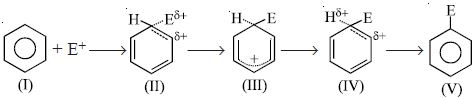
Which of the following species is expected to have maximum enthalpy in an electrophilic aromatic substitution reaction ?
$MnO_4^ -  + B{r^ - } + {H_2}O \to Mn{O_2} + BrO_3^ -$ $+ O{H^ - }$ In balanced reaction the coefficients of $MnO_4 ^-, BrO_3 ^-$ and $OH^-$are respectively