MCQ
Which complex compound is most stable?
  • A
    $\left[ Co \left( NH _3\right)_6\right]_2\left( SO _4\right)_3$
  • B
    $\left[ Co \left( NH _3\right)_4\left( H _2 O \right) Br \right]\left( NO _3\right)_2$
  • C
    $\left[ Co \left( NH _3\right)_3\left( NO _3\right)_3\right]$
  • $\left[ CoCl _2(\text { en })_2\right] NO _3$

Answer

Correct option: D.
$\left[ CoCl _2(\text { en })_2\right] NO _3$
d
Chelating ligands in general form more stable complexes than their monodentate analogs

$\therefore$ The most stable complex is $\left[ CoCl _2( en )_2\right] NO _3$

Need a full question paper?

Generate a complete, print-ready paper with questions like this in minutes — across 16+ boards, with answer keys.

Start Generating Free

Similar questions

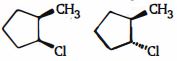
The following compounds are identical with respect to
The standard reduction potentials at $298 \mathrm{~K}$ for the following half cells are given below :

$\mathrm{Cr}_2 \mathrm{O}_7{ }^{2-}+14 \mathrm{H}^{+}+6 \mathrm{e}^{-} \rightarrow 2 \mathrm{Cr}^{3+}+7 \mathrm{H}_2 \mathrm{O}, \mathrm{E}^{\circ}=1.33 \mathrm{~V}$

$\mathrm{Fe}^{3+}(\mathrm{aq})+3 \mathrm{e}^{-} \rightarrow \mathrm{Fe}  \mathrm{E}^{\circ}=-0.04 \mathrm{~V}$

$\mathrm{Ni}^{2+}(\mathrm{aq})+2 \mathrm{e}^{-} \rightarrow \mathrm{Ni}  \mathrm{E}^{\circ}=-0.25 \mathrm{~V}$

$\mathrm{Ag}^{+}(\mathrm{aq})+\mathrm{e}^{-} \rightarrow \mathrm{Ag} \mathrm{E}^{\circ}=0.80 \mathrm{~V}$

$\mathrm{Au}^{3+}(\mathrm{aq})+3 \mathrm{e}^{-} \rightarrow \mathrm{Au} \mathrm{E}^{\circ}=1.40 \mathrm{~V}$

Consider the given electrochemical reactions, The number of metal$(s)$ which will be oxidized be $\mathrm{Cr}_2 \mathrm{O}_7{ }^{2-}$, in aqueous solution is. . . . . . 
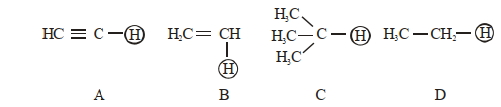
The ascending acidity order of the following $\mathrm{H}$ atoms is $IMAGE$
Which of the following statements is not valid for oxoacids of phosphorus ?
Which of the following compounds can show geometrical isomerism :
$(I)\, CH_3-CH=CH-CH_2-CH_3$

$(II)$ (figure)

$(III)\, CH_3-N=CH_2$
$(IV)\, C_2H_5-CH=N-OH$

Which of the following is the correct formula for a compound of scandium and oxygen?
Which of the following carbohydrates does not show mutarotation?
The compound which on reaction with aqueous nitrous acid on $HN{O_2}$ at low temperature produces an oily nitrosoamine is
Benzoylation of phenol with benzoyl chloride in the presence of dilute $NaOH$ gives phenyl benzoate. This reaction is an example of
If $20\,ml$ of $0.4\,N\,NaOH$ solution completely neutralises $40\,ml$ of a dibasic acid. The molarity of the acid solution is ..........  $M$