MCQ
Which complex is most stable ?

Where $kd =$ Dissociation constant

  • A
    $[Cu(CN)_2]^-; Kd = 1 \times 10^{-16}$
  • B
    $[Fe(CN)_6^-]^{-4} ; Kd = 1 \times 10^{-37}$
  • $[Fe(CN)_6]^{-3} ; Kd = 1 \times 10^{-44}$
  • D
    $[Ag(CN)_2]^-; Kd = 1 \times 10^{-20}$

Answer

Correct option: C.
$[Fe(CN)_6]^{-3} ; Kd = 1 \times 10^{-44}$
c
The stability constant or the dissociation constant is the equilibrium constant for the dissociation of the metal ligand bond. Higher is the stability constant, higher is the stability of the complex. The stability constant of $\left[ Fe ( CN )_{6}\right]^{3-}$ is $K _{d}=1 \times 10^{-44}$. It is minimum among the given
complexes. Hence, the complex $\left[ Fe ( CN )_{6}\right]^{3-}$ is most stable.

Need a full question paper?

Generate a complete, print-ready paper with questions like this in minutes — across 16+ boards, with answer keys.

Start Generating Free

Similar questions

A pink coloured salt turns blue on heating. The presence of which cation is most likely ?
Visible light will be absorbed by
The amount of urea to be dissolved in $500\,ml$ of water ($K =18.6\,K$  $mol{e^{ - 1}}$ in  $100\,g$  solvent) to produce a depression of ${0.186\,^o}C$ in freezing point is ....... $g$.
The maximum number of possible oxidation states of actinoids are shown by
Reaction of cyclohexanone with dimethylamine in the presence of catalytic amount of an acid forms a compounds if water during the reaction is continuously removed. The compound formed is generally known as
$\underset{(A)}{\mathop{\begin{matrix}
   \,\,\,\,\,Ph\,\,\,\,C{{H}_{3}}  \\
   |\,\,\,\,\,\,\,\,\,\,|\,\,  \\
   Ph-C-C-C{{H}_{3}}  \\
   |\,\,\,\,\,\,\,\,\,\,|\,\,\,  \\
   \,OH\,\,\,OH  \\
\end{matrix}}}\,+\underset{(B)}{\mathop{\begin{matrix}
   \,\,\,\,Ph\,\,\,Et  \\
   \,\,|\,\,\,\,\,\,\,\,\,|  \\
   Ph-C-C-Et  \\
   \,\,|\,\,\,\,\,\,\,\,\,|  \\
   \,\,\,\,\,OH\,\,OH  \\
\end{matrix}}}\,\xrightarrow{{{H}_{2}}S{{O}_{4}}}$


$(p)$ $\begin{matrix}
   Ph\,\,\,\,\,O\,  \\
   |\,\,\,\,\,\,\,\,||\,\,  \\
   Ph-C-C-C{{H}_{3}}  \\
   |\,\,\,\,\,\,\,\,\,\,\,\,  \\
   C{{H}_{3}}\,\,\,\,\,\,\,\,  \\
\end{matrix}$                                $(q)$ $\begin{matrix}
   \,Ph\,\,\,\,\,O\,  \\
   \,\,|\,\,\,\,\,\,\,\,||  \\
   Ph-C-C-Et  \\
   |\,\,\,\,\,\,\,\,\,\,  \\
   Et\,\,\,\,\,\,\,\,\,\,  \\
\end{matrix}$

$(r)$ $\begin{matrix}
   \,Ph\,\,\,\,\,O\,  \\
   |\,\,\,\,\,\,\,\,\,\,||\,  \\
   Ph-C-C-C{{H}_{3}}  \\
   |\,\,\,\,\,\,\,\,\,\,\,\,\,\,  \\
   Et\,\,\,\,\,\,\,\,\,\,\,\,\,  \\
\end{matrix}$                             $(s)$ $\begin{matrix}
   \,\,\,Ph\,\,\,\,\,O\,  \\
   \,\,|\,\,\,\,\,\,\,\,||  \\
   Ph-C-C-Et  \\
   |\,\,\,\,\,\,\,\,\,\,  \\
   C{{H}_{3}}\,\,\,\,  \\
\end{matrix}$

When $(A)$ and $(B)$ reacts with $H_2SO_4$ products obtained are
Which of the following alcohol does not give a stable compound on dehydration?
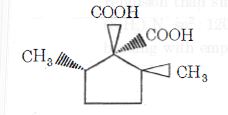
How many organic products will be formed when the following compound undergoes decarboxylation?
Among the following, the nurnber of compounds than can react with $PCl _5$ to give $POCl _3$ is $O _2, CO _2, SO _2, H _2 O , H _2 SO _4, P _4 O _{10}$
The strongest acid among the following aromatic compounds is