MCQ
Which compound does not possess linear geometry
  • $C{H_2} = C{H_2}$
  • B
    $HC \equiv CH$
  • C
    $BeC{l_2}$
  • D
    $C{O_2}$

Answer

Correct option: A.
$C{H_2} = C{H_2}$
(a)Alkene does not show linear structure but it has planar structure due to $s{p^2}$-hybridisation.

Need a full question paper?

Generate a complete, print-ready paper with questions like this in minutes — across 16+ boards, with answer keys.

Start Generating Free

Similar questions

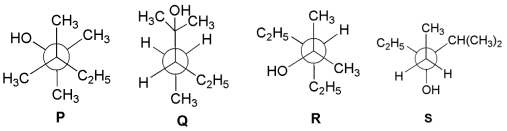
Newman projections $P , Q , R$ and $S$ are shown below :

Which one of the following options represents identical molecules?
The rate of a reaction is doubled for every ${10\,^o}$ rise in temperature. The increase in reaction rate as a result of temperature rise from ${10\,^o}$ to ${100\,^o}$ is
Which of the following triatomic molecules does not exist ?
'$R$' formed in the following sequence of reaction is:
For the reaction :

$NH_3{_{(g)}}\ \rightleftharpoons \ \frac {1}{2} {N_2}_{(g)} + \frac {3}{2} {H_2}_{(g)}$ ; $K_P$

The degree of dissociation $(\alpha )$ of $NH_3$ is related to total equilibrium pressure $(P^o )$ as 

Haloforms are trihalogen derivatives of
Match List $I$ with List $II$

List-$I$ (Elements) List-$II$(Properties in their respective groups)
$A$ $\mathrm{Cl}, \mathrm{S}$ $I$ Elements with highest electronegativity
$B$ $\mathrm{Ge}, \mathrm{As}$ $II$ Elements with largest atomic size
$C$ $\mathrm{Fr}, \mathrm{Ra}$ $III$ Elements which show properties of both metals and non metal
$D$ $\mathrm{F}, \mathrm{O}$ $IV$ Elements with highest negative electron gain enthalpy

Choose the correct answer from the options given below :
An aqueous solution is prepared by dissolving $0.1 mol$ of an ionic salt in $1.8 kg$ of water at $35^{\circ} C$. The salt remains $90 \%$ dissociated in the solution. The vapour pressure of the solution is $59.724 mm$ of $Hg$. Vapor pressure of water at $35^{\circ} C$ is $60.000 mm$ of $Hg$. The number of ions present per formula unit of the ionic salt is. . . . . . .
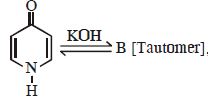
$B$ is
If the radius of first orbit of $H$ atom is $a_0$, the de-Broglie wavelength of an electron in the third orbit is