MCQ
Which crystal is used in the Davisson $–$ Germer experiment?
  • A
    Aluminum
  • Nickel
  • C
    Cobalt
  • D
    Zinc

Answer

Correct option: B.
Nickel

The crystal used in the Davisson $–$ Germer experiment is nickel. A fine beam of electrons is made to fall on the surface of the nickel crystal. As a result, the electrons are scattered in all directions by the atoms of the crystal.

Need a full question paper?

Generate a complete, print-ready paper with questions like this in minutes — across 16+ boards, with answer keys.

Start Generating Free

Similar questions

Three capacitors of 2μF, 3μF and 6μF are joined in series and the combination is charged by means of a 24 volt battery. The potential difference between the plates of the 6 μF capacitor is
The dependence of drift velocity on applied electric field $E$ is:
Assertion : Faraday’s laws are consequences of conservation of energy.

Reason : In a purely resistive $A.C.$ circuit, the current lags behind the $e.m.f.$ in phase.

If in a coil rate of change of area is $5 \mathrm{~m}^2 / \mathrm{milli~second}$ and current become 1 amp from 2 amp in $2 \times 10^{-3} \mathrm{sec}$ If magnitude of field is 1 tesla then self inductance of the coil is
A plot of the number of neutrons $(N)$ against the number of protons ( $P$ )of stable nuclei exhibits upward deviation from linearity for atomic number, $Z>20$. For an unstable nucleus having $N / P$ ratio less than $1$ , the possible mode($s$) of decay is(are)

($A$) $\beta^{-}$-decay ( $\beta$ emission)

($B$) orbital or $K$-electron sasture

($C$) neutron emission

($D$) $\beta^{+}$-decay (positron emission)
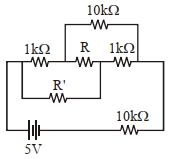
When the resistance $R$ (indicated in the figure below) is changed from $1 \,k \Omega$. to $10 \,k \Omega$, the current flowing through the resistance $R'$ does not change. What is the value of the resistor $R'?$
Two point charges $+8q$ and $ - 2q$ are located at $x = 0$ and $x = L$ respectively. The location of a point on the $x$-axis at which the net electric field due to these two point charges is zero is
A double slit experiment is performed by using light of wavelength of $6000\,\mathring A$. If distance of screen is $1\,m$ and slits are $0.1\, cm$ apart then calculate angular position of $10^{th}$ bright fringe
Minimum deviation is observed with a prism having angle of prism A, angle of deviation δ, angle of incidence i and angle of emergence e. We then have generally
Which of the following phenomena cannot be explained by the Huygens' wave theory?