MCQ
Which decay increases the atomic number?
- A$\beta^-$decay
- B$\beta^+$ decay
- CElectron capture
- DGamma decay
Explanation:
$\beta^-$ decay: $_\text{Z}^\text{A}\text{X}→_{\text{Z}+1}^{\text{A}}\text{Y} + _{−1}^0\text{e}$
Thus, the atomic number is increased in $\beta^-$ decay.
Generate a complete, print-ready paper with questions like this in minutes — across 16+ boards, with answer keys.
The average kinetic energy of the thermal neutrons is of the order of (Boltzmann's constant 
|
(a) 0.03 eV |
(b) 3 eV |
(c) 3 KeV |
(d) 3 MeV |
A  at rest decays into 2γ rays
  . Then which of the following can happen
|
(a) The two |
|
(b) The two |
|
(c) Both repel each other |
|
(d) Both attract each other |
The wavelength of light visible to eye is of the order of
|
(a) |
(b) |
(c) 1 m |
(d) 6 |
A 10 m long wire of 20W resistance is connected with a battery of 3 volt e.m.f. (negligible internal resistance) and a 10 W resistance is joined to it is series. Potential gradient along wire in volt per meter is
|
(a) 0.02 |
(b) 0.3 |
(c) 0.2 |
(d) 1.3 |
The potential difference between points A and B of adjoining figure is
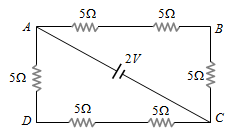
(a) 
|
(b) 
|
(c) |
(d) 2 V |
The explosion of the atomic bomb takes place due to
|
(a) Nuclear fission |
(b) Nuclear fusion |
|
(c) Scattering |
(d) Thermionic emission |
$\frac{1}{4}\text{mgR}$
$\frac{1}{2}\text{mgR}$
$\text{mgR}$
$2\text{mgR}$


