MCQ
Which decay increases the atomic number?
  • A
    $\beta^-$decay
  • $\beta^+$ decay
  • C
    Electron capture
  • D
    Gamma decay

Answer

Correct option: B.
$\beta^+$ decay

$\beta^-$ decay: $_\text{Z}^\text{A}\text{​X}→_{\text{Z}+1}^{\text{A}}\text{​Y} + _{−1}^0\text{​e}$
Thus, the atomic number is increased in $\beta^-$ decay.

Need a full question paper?

Generate a complete, print-ready paper with questions like this in minutes — across 16+ boards, with answer keys.
Start Generating Free

Similar questions

The electronic transition from $n = 2$ to $n = 1$ will produce shortest wavelength in:
What is the ratio of the speed of infrared and ultraviolet rays in a vacuum?
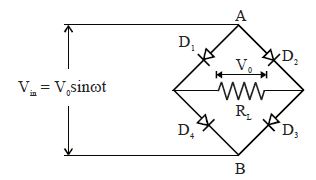
For a given circuit output voltage across load Resistance will be
Primary side of a transformer is connected to $230 \mathrm{~V}, 50 \mathrm{~Hz}$ supply. Turns ratio of primary to secondary winding is $10: 1$. Load resistance connected to secondary side is $46\  \Omega$. The power consumed in it is :
Photon and electron are given same energy ($10^{-20} \mathrm{~J}$). Wavelength associated with photon and electron are $\lambda_{\mathrm{ph}}$ and $\lambda_{\mathrm{el}}$ then correct statement will be
Photon of $5.5 eV$ energy fall on the surface of the metal emitting photoelectrons of maximum kinetic energy $4.0 eV$. The stopping voltage required for these electrons are .......... $V$
The ratio of secondary to the primary turns in a transformer is $3 : 2$. If the power output be $P$, then the input power neglecting all loses must be equal to
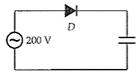
In the circuit given in the figure, an a.c. source of 200 V is connected through a diode D to a capacitor. The potential difference across the capacitor will be

Image
A radioactive sample disintegrates via two independent decay processes having half lives $T _{1 / 2}^{(1)}$ and $T _{1 / 2}^{(2)}$ respectively. The effective half- life $T _{1 / 2}$ of the nuclei is
In an ac circuit, the instantaneous current is zero, when the instantaneous voltage is maximum. In this case, the source may be connected to:

$A$. pure inductor.

$B$. pure capacitor.

$C$. pure resistor.

$D$. combination of an inductor and capacitor.

Choose the correct answer from the options given below: