MCQ
Which electron transition in a hydrogen atom requires the largest amount of energy :
- ✓From $n = 1$ to $n = 2$
- BFrom $n = 2$ to $n = 3$
- CFrom $n = \infty$ to $n = 1$
- DFrom $n = 3$ to $n = 5$
The amount of energy is directly proportional to
$\left[\frac{1}{ n _1^2}-\frac{1}{ n _2^2}\right]$
This difference is maximum for the electron transition from $n=1$ to $n=2$
$\left[\frac{1}{1^2}-\frac{1}{2^2}\right]=0.75$
Generate a complete, print-ready paper with questions like this in minutes — across 16+ boards, with answer keys.
$I$ || $II$ || $III$ || $IV$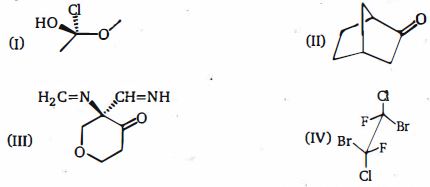
$(i)$ $\begin{gathered}
HCN\left( {aq} \right) + {H_2}O\left( l \right) \rightleftharpoons {H_3}{O^ + }\left( {aq} \right) + C{N^ - }\left( {aq} \right) \hfill \\
{K_a} = 6.2 \times {10^{ - 10}} \hfill \\
\end{gathered} $
$(ii)$ $\begin{gathered}
C{N^ - }\left( {aq} \right) + {H_2}O\left( l \right) \rightleftharpoons HCN\left( {aq} \right) + O{H^ - }\left( {aq} \right) \hfill \\
{K_b} = 1.6 \times {10^{ - 5}} \hfill \\
\end{gathered} $
These equilibria show the following order of the relative base strength