MCQ
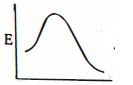
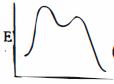
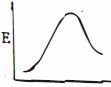
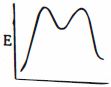
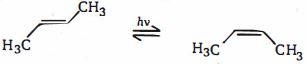
Which energy diagram best represents the given reaction ?
  • A

  • B

  • C


Answer

Correct option: D.

d
$(d)$ It is possible to interconvert cis and trans alkenes, but the $\pi$ -bond  must be broken first. This requires a considerable amount of energy - around $260\, kJ\, mol^{-1}$ .One way to break the $\pi$ -bond would be to promote an  electron from the $\pi$ -orbital to the $\pi^*$ -orbital. If this were to happen,  there would be one electron in the bonding $\pi$ -orbital and one in the antibonding $\pi^*$ -orbital and hence no overall bonding. Electromagnetic  radiation of the correct energy could promote the electron from $HOMO$ to  $LUMO$. The correct energy actually corresponds to light in the ultraviolet $(UV)$ region of the spectrum. Thus, shining $UV$ light on an alkene would  promote an electron from its bonding $\pi$ -molecular orbital to its antibonding  $\pi^*$ -molecular orbital, thereby breaking the $\pi$ -bond (but not the $\sigma$ - bond)  and allowing rotation to occur.

Need a full question paper?

Generate a complete, print-ready paper with questions like this in minutes — across 16+ boards, with answer keys.

Start Generating Free

Similar questions

The suitable expression for the equilibrium constant of the reaction $2N{O_{(g)}} + C{l_{2(g)}}$ $\rightleftharpoons$ $2NOC{l_{(g)}}$ is
Decreasing order of bond angle is
At $300\, K$ temperature the standard heat of formation of benzoic acid$_{(s)}, CO_2(g)$  and $H_2O_{(l)}$ are $-408, -393$ and $-286\, KJ \,mol^{-1}$ respectively. At constant pressure the heat of combustion for benzoic acid will be .....$ KJ$
For preparing $0.1\, N$ solution of a compound from its impure sample of which the percentage purity is known, the weight of the substance required will be
Which of the following fluoro-compounds is most likely to behave as a Lewis base?
Bleaching powder and bleach solution are produced on a large scale and used in several house hold products.

The effectiveness of bleach solution is often measured by iodometry.

$1.$ $25 mL$ of household bleach solution was mixed with $30 \ mL$ of $0.50 \ M \ KI$ and $10 \ mL$ of $4 \ N$ acetic acid. In the titration of the liberated iodine, $48 \ mL$ of $0.25 \ N \ Na _2 S _2 O _3$ was used to reach the end point. The molarity of the household bleach solution is

$(A)$ $0.48 \ M$ $(B)$ $0.96 \ M$ $(C)$ $0.24 \ M$ $(D)$ $0.024 \ M$

$2.$ Bleaching powder contains a salt of an oxoacid as one of its components. The anhydride of that oxoacid is

$(A)$ $Cl _2 O$ $(B)$ $Cl _2 O _7$ $(C)$ $ClO _2$ $(D)$ $Cl _2 O _6$

Give the answer question $1$ and $2.$

The strength of an aqueous solution of $I_2$ can be determined by titrating the solution with standard solution of:
If for a given substance melting point is ${T_B}$ and freezing point is ${T_A}$, then correct variation shown by graph between entropy change and temperature is
Glycerol is purified by :
Tin is obtained from cassiterite by reduction with coke. Use the data given below to determine the minimum temperature (in $K$ ) at which the reduction of cassiterite by coke would take place.

At $ 298 K : \Delta_{ f } H ^{\circ}\left( SnO _2( s )\right)=-581.0 kJ mol ^{-1}, \Delta_{ fH } H ^{\circ}\left( CO _2( g )\right)=-394.0 kJ mol ^{-1}$

$S ^{\circ}\left( SnO _2( s )\right)=56.0 J K ^{-1} mol ^{-1}, S ^{\circ}( Sn ( s ))=52.0 J K ^{-1} mol ^{-1}$

$S ^{\circ}( C ( s ))=6.0 J K ^{-1} mol ^{-1}, S ^{\circ}\left( CO _2( g )\right)=210.0 J K ^{-1} mol ^{-1}$

Assume that the enthalpies and the entropies are temperature independent.