MCQ
Which force prevents us from slipping while walking on the road?
  • A
    Muscular force of our body.
  • B
    Gravitational pull by the earth.
  • Frictional force.
  • D
    Balanced forces of nature.

Answer

Correct option: C.
Frictional force.
When we push the ground with our feet, the friction provides a forward reaction to our push and makes us move forward. $($Walking on slippery ground is difficult because the frictional force is not enough to prevent slipping$).$

Need a full question paper?

Generate a complete, print-ready paper with questions like this in minutes — across 16+ boards, with answer keys.

Start Generating Free

Similar questions

Arvind is doing his homework which is given by his teacher. Would you help him to choose the correct sentences?
Which of the following statements is/ are correct?
$(i)$
The nucleoplasm and the cytoplasm together make up the protoplasm.
$(ii)$
Chloroplasts are a type of plastids, which occur in plant cells.
$(iii)$
In many multicellular organisms, all cells have projections called cilia and flagella.
$(iv)$
Cell destruction occurs by centrosomes.
Force acting on a surface in a direction perpendicular to it is known as
The Angle between the incident ray and the normal is called
The petroleum product which is not used as fuel is:
Voice of which of the following is likely to have the minimum frequency?
What property of air allows it to exert pressure in different directions?
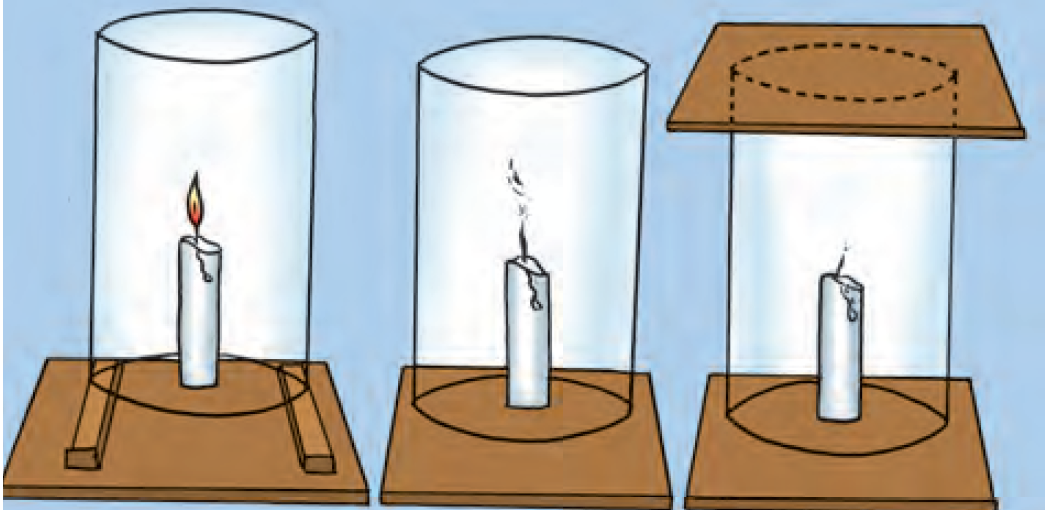
Three candles $X, Y,$ and $Z$ are fixed on a table. A glass chimney is placed over candle $X$, and is rested on wooden blocks in a manner which allows the entrance of oxygen. To candle $Y$, a glass chimney is placed in such a way that it is simply rested on the table. For candle $Z$, a similar arrangement is made along with the placement of a glass plate over the chimney. Candle _____$i$____ bums freely. The flame of candle _____$ii$_____ will flicker off giving smoke, and that of candle _____$iii$_____ will simply go off.

The information in which alternative completes the given statements?
Which of the following elements will produce an oxide that will dissolve in water to form an acid?
Cell theory was given by: