MCQ
Which forms coloured salts
  • A
    Metals
  • B
    Non-metals
  • C
    $p -$  block elements
  • Transitional elements

Answer

Correct option: D.
Transitional elements
d
(d)Transitional elements form coloured salts due to the presence of unpaired electrons in $ d-$ orbital.

Need a full question paper?

Generate a complete, print-ready paper with questions like this in minutes — across 16+ boards, with answer keys.

Start Generating Free

Similar questions

An amino acid may be represented by general formula $\begin{matrix}
   R\,\,\,\,\,\,\,\,  \\
   |\,\,\,\,\,\,\,\,  \\
   {{H}_{2}}N-CH-COOH  \\
\end{matrix}$ If $R = -CH_2C_6H_5$ then it is phenylalanine $(Phe)$ and if $R = CH_3$ then it is alanine $(Ala)$. Find the sequence of reagents from those given below to synthesize $Phe- Ala$

$(1)$ $\begin{matrix}
   C{{H}_{3}}  \\
   |\,\,\,\,\,\,  \\
   ZNH\,C\,HC{{O}_{2}}H  \\
\end{matrix}$                             $(2)$ $\begin{matrix}
   C{{H}_{3}}\,\,\,\,\,\,\,\,\,\,\,\,\,\,\,\,\,\,\,\,  \\
   |\,\,\,\,\,\,\,\,\,\,\,\,\,\,\,\,\,\,\,\,\,\,\,\,\,\,\,\,  \\
   {{H}_{2}}N\,C\,HC{{O}_{2}}C{{H}_{2}}{{C}_{6}}{{H}_{5}}  \\
\end{matrix}$

$(3)$ $\begin{matrix}
   \,\,\,\,\,\,\,\,\,\,\,\,C{{H}_{3}}{{C}_{6}}{{H}_{5}}  \\
   |\,\,\,\,\,  \\
   ZNH\,C\,HC{{O}_{2}}H  \\
\end{matrix}$                $(4)$ $\begin{matrix}
   C{{H}_{2}}{{C}_{6}}{{H}_{5}}\,\,\,\,\,  \\
   |\,\,\,\,\,\,\,\,\,\,\,\,\,\,\,\,\,\,\,\,\,\,\,\,\,\,\,  \\
   {{H}_{2}}N\,CHC{{O}_{2}}C{{H}_{2}}{{C}_{6}}{{H}_{5}}  \\
\end{matrix}$

Super alloys are usually
Product $(D)$ is

$\begin{array}{*{20}{c}}
  {\,\,\,\,\,O} \\ 
  {\,\,\,\,\,||} \\ 
  {HOC{H_2}C{H_2} - C - OC{H_2}C{H_3}} 
\end{array}$ $\xrightarrow{{PCC}}(A)\,\xrightarrow[{(1\,\,molar\,\,equivalent)}]{{{H_2}C \equiv CHMgBr}}(B)$ $\xrightarrow{{N{H_4}Cl\,/\,{H_2}O}}\,(C)\,\,\xrightarrow[{{H_2}O}]{{KOH}}\,$ $\xrightarrow{{{H_3}{O^ \oplus }}}\,\,\xrightarrow[{pyridine}]{{\begin{array}{*{20}{c}}
  {\,\,\,\,\,\,\,O} \\ 
  {\,\,\,\,\,\,||} \\ 
  {{{(C{H_3} - C)}_2}O} 
\end{array}}}(D)$
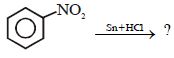
What is the product obtained in the following reaction
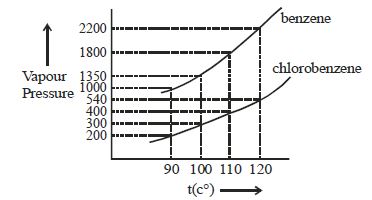
Assuming the formation of an ideal solution, determine the boiling point of a mixture containing $1560\, g$ benzene (molar mass $= 78$) and $1125\, g$ chlorobenzene (molar mass $= 112.5$) using the following against an external pressure of $1000\, torr$ .......... $^oC$.
Phenol is obtained by heating aqueous solution of
$3.4\, gm\, H_2O_2$ is present in its $112\, ml$ solution. Volume strength of this solution is ....... $V$.
The smallest ketone and its next homologue are reacted with $\mathrm{NH}_2 \mathrm{OH}$ to form oxime.
Decomposition of benzene diozonium chloride by using $\ce{Cu_2Cl_2/HCl}$ to form chlorobenzene is:
Which of the following are example of synthetic rubber?
$a.$ Polychloroprene.
$b.$ Polyacrylonitrile.
$c.$ Buna$-N.$
$d.$ cis$-$polyisoprene.