MCQ
Which gas is liberated when $A{l_4}{C_3}$ is hydrolysed
- ✓$C{H_4}$
- B${C_2}{H_2}$
- C${C_2}{H_6}$
- D$C{O_2}$
Generate a complete, print-ready paper with questions like this in minutes — across 16+ boards, with answer keys.
$\mathop {CH_3^ + }\limits_{\rm{I}} $ $\mathop {{H_3}{O^ + }}\limits_{{\rm{II}}} $ $\mathop {N{H_3}}\limits_{{\rm{III}}} $ $\mathop {CH_3^ - }\limits_{{\rm{IV}}} $
$(A)$ Compounds $P$ and $Q$ are carboxylic acids.
$(B)$ Compound $S$ decolorizes bromine water.
$(C)$ Compounds $P$ and $S$ react with hydroxylamine to give the corresponding oximes.
$(D)$ Compound $R$ reacts with dialkylcadmium to give the corresponding tertiary alcohol.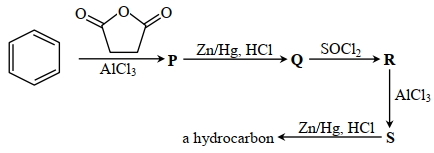
$Zn ^{2+}+2 e ^{-} \rightarrow Zn ; E ^{\circ}=-0.760 \,V$
$Ag _{2} O + H _{2} O +2 e ^{-} \rightarrow 2 Ag +2 OH ^{-} ; E ^{\circ}=0.344 \,V$
If $F$ is $96,500 C mol ^{-1}$ $\Delta G ^{\circ}$ of the cell will be $....$ (In $kJ mol ^{-1}$)
$X \left| X ^{2+}(0.001 M ) \| Y ^{2+}(0.01 M )\right| Y$
is $.......\times 10^{-2} V$ (Nearest integer).
Given: $E _{ x ^{2+} \mid x }^0=-2.36\,V$
$E _{ Y ^{3+} \mid Y }^0=+0.36\,V$
$\frac{2.303\,RT }{ F }=0.06\,V$