MCQ
Which give colored carbonate precipitate ?
  • A
    $Hg _{2}^{2+}$
  • B
    $Sr ^{2+}$
  • C
    $Li ^{+}$
  • $Bi ^{+3}$

Answer

Correct option: D.
$Bi ^{+3}$
d
The carbonate of bismuth ion has a pale yellow color. On the other hand, the carbonates of $Hg _{2}^{+2}, \,Sr ^{+2}$ and $Li ^{+}$ have no color.

Need a full question paper?

Generate a complete, print-ready paper with questions like this in minutes — across 16+ boards, with answer keys.

Start Generating Free

Similar questions

Predict the correct product when $Cl_2$ passed through $H-\overset{1\,s}{\mathop{O}}\,-\overset{1\,s}{\mathop{O}}\,-H$ solution.
Ethylamine can be prepared by the action of bromine and caustic potash on
A binary liquid solution is prepared by mixing $n-$ heptaneand ethanol. Which one of the following statements is correct regarding the behaviour of the solution ?
Complete reaction of acetaldehyde with excess formaldehyde, upon heating with conc. $NaOH$ solution, gives $P$ and $Q$. Compound $P$ does not give Tollens' test, whereas $Q$ on acidification gives positive Tollens' test. Treatment of $P$ with excess cyclohexanone in the presence of catalytic amount of $p$-toluenesulfonic acid (PTSA) gives product $R$.

Sum of the number of methylene groups $\left(- CH _2-\right.$ ) and oxygen atoms in $R$ is. . . .

$\begin{array}{*{20}{c}}
  {\,\,\,\,\,\,\,\,\,\,\,\,\,\,\,\,\,\,\,\,\,\,\,\,\,\,\,\,\,\,\,\,\,\,\,\,O} \\ 
  {\,\,\,\,\,\,\,\,\,\,\,\,\,\,\,\,\,\,\,\,\,\,\,\,\,\,\,\,\,\,\,\,\,\,\,\,||} \\ 
  {PhMgBr{\text{ }} + {\text{ }}C{H_3}{\text{ }} - CN\xrightarrow[{{H_3}{O^ \oplus }}]{}(A)Ph - C - O - H\xrightarrow[{(2){H_3}O}]{{\left( 1 \right){\text{ }}excess{\text{ }}C{H_3}Li}}(A)} 

\end{array}$

Same product $(A)$ will form in both reactions $A$ is

Which of the following statement is not correct?
$C_6H_{13}Br + OH^- \to C_6H_{13}OH + Br^-$ is an example of
If $279 \mathrm{~g}$ of aniline is reacted with one equivalent of benzenediazonium chloride, the mximum amount of aniline yellow formed will be . . . . . . .$g$. (nearest integer)

(consider complete conversion)

$5$ milli-moles of a solid $A$ was dissolved in $5$ moles of $H_2O$ . On adding to the solvent, $A$  starts polymerising into another insoluble solid following zero order kinetics. On adding $6$ milli-moles of another solid solute $C$ (after $20$ minute) the polymerisation completely stops. The  nsoluble solid polymer is removed and the resulting solution was cooled to a temperature less  than $- 0.186\,^oC$ (melting point of solution) to cause solidification of some liquid water. Calculate the value of $'X'$ if rate constant for polymerisation reaction is represented as $10^{-X}\,moles/minute$ . $[K_f(H_2O) = 1.86\, K\,- Kg\,mole^{-1}]$
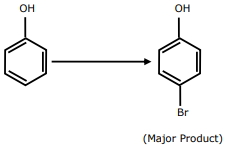
The given reaction can occur in the presence of:

$(1)$ Bromine water        $(2)$ $\mathrm{Br}_{2}$ in $\mathrm{CS}_{2}, 273 \mathrm{~K}$       $(3)$ $\mathrm{Br}_{2} / \mathrm{FeBr}_{3}$    $(4)$ $\mathrm{Br}_{2}$ in $\mathrm{CHCl}_{3}, 273 \,\mathrm{~K}$

Choose the correct answer from the options given below: