MCQ
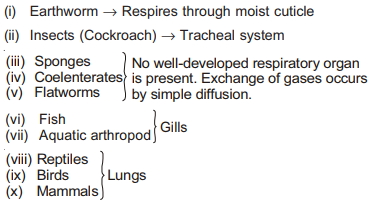
Which group of animals respire through lungs?
  • A
    Earthworm and insects
  • B
    Sponges, coelenterates and flatworms
  • C
    Fishes and aquatic arthropods
  • Reptiles, birds and mammals

Answer

Correct option: D.
Reptiles, birds and mammals
d

Need a full question paper?

Generate a complete, print-ready paper with questions like this in minutes — across 16+ boards, with answer keys.

Start Generating Free

Similar questions

True coelom is covered by
Which of the following statements are incorrect for spermatogenesis ?
(i) In testis, the immature male germ ceils spermatogonia produce sperms by spermatogenesis that begins at puberty.
(ii) Some of the spermatogonia called primary spermatocytes periodically undergo meiosis.
(iii) The spermatids are transformed into spermatozoa (sperms) by the process called spermiogenesis.
(iv) Sperm released from the seminiferous tubules by the process called spermiation.
(v) Spermatogenesis starts at the age of puberty due to significant increase in the secretion of gonadotropin releasing hormone (GnRH).
(vi) Androgens stimulate the process of spermatogenesis.
(vii) FSH acts on the Sertoli cells and stimulates secretion of some factors which help in the process of spermiogenesis.
Saltatory conduction occurs in:
Corpus luteum in mammals is present in
Which one is the incorrect statement with regard to the importance of pedigree analysis?
After examining the blood groups of husband and wife, the doctor advised them not to have more than one child, the blood group of the couple are likely to be
Gynaecomastia is the symptom of
Which cells in the testis secrete testosterone
A healthy individual has ...$A$... grams of haemoglobin in every ...$B$... mL of blood. These molecules plays a significant role in the transport of ...$C$... gases

Choose the correct option for $A , B$ and $C$

Assertion : Mast cells in the human body release excessive amounts of inflammatory chemicals, which cause allergic reactions.

Reason : Allergens in the environment on reaching human body stimulate mast cells in certain individuals.