MCQ
Which has highest number of atoms ?
  • A
    $11.2\, L$ of $CO_2$ gas at $STP$
  • B
    $2\,g$ of $H_2$
  • C
    $2\,g-$ atom of $C$
  • $3\,g-$ molecule of $SO_2$

Answer

Correct option: D.
$3\,g-$ molecule of $SO_2$
d
$\mathrm{CO}_{2} \Rightarrow \frac{11.2}{22.4} \times \mathrm{N}_{\mathrm{A}} \times 3=1.5 \mathrm{N}_{\mathrm{A}}$ atoms

$\mathrm{H}_{2} \Rightarrow \frac{2 \mathrm{g}}{2} \times \mathrm{N}_{\mathrm{A}} \times 2=2 \mathrm{N}_{\mathrm{A}}$ atoms

$\mathrm{C} \Rightarrow 2 \times \mathrm{N}_{\mathrm{A}}$ atoms

$\mathrm{SO}_{2} \Rightarrow 3 \times \mathrm{N}_{\mathrm{A}} \times 3=9 \mathrm{N}_{\mathrm{A}}$ atoms

Need a full question paper?

Generate a complete, print-ready paper with questions like this in minutes — across 16+ boards, with answer keys.

Start Generating Free

Similar questions

$0.5\, M$ ammonium benzoate is hydrolysed to $0.25$ percent, hence its hydrolysis constant is
Of the following four aqueous solutions, total number of those solutions whose freezing point is lower than that of $0.10\, \mathrm{M} \mathrm{C}_{2} \mathrm{H}_{5} \mathrm{OH}$ is (Integer answer)

$(i)$ $0.10\, \mathrm{M} \,\mathrm{Ba}_{3}\left(\mathrm{PO}_{4}\right)_{2}$            $(ii)$ $0.10\, \mathrm{M}\, \mathrm{Na}_{2} \mathrm{SO}_{4}$             $(iii)$ $0.10\, \mathrm{M}\, \mathrm{KCl}$          $(iv)$ $0.10 \,\mathrm{M} \,\mathrm{Li}_{3} \mathrm{PO}_{4}$
A galvanic cell with electrode potential of $'A' = + 2.23\;V$ and $'B' = - 1.43\;V$. The value of $E{^o _{cell}}$ is .............. $\mathrm{V}$
$25\,ml$ of a solution of barium hydroxide on titration with a $0.1\,molar$ solution of hydrochloric acid gave a litre value of $35\,ml$ . The molarity of barium hydroxide solution was
Iodine is formed when potassium iodide reacts with a solution of
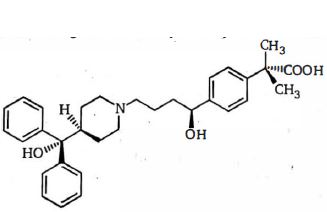
Allegra, a common prescription drug with the structure shown below, is given for  the treatment of seasonal allergies. How many stereogenic carbon does Allegra possess ?
Under the specified conditions, substrate $X$ undergoes substitution and  elimination reactions to give products $A - D. A$ and $B$ are stereoisomers, but  not enantiomers. $C$ and $D$ are enantiomers. $A$ is not an isomer of $C$. Which of the following could be the starting material $X$ ?

$X\xrightarrow[\Delta ]{{{H}_{2}}O}A+B+C+D$

An increase in molar conductance of a strong electrolyte with dilution is mainly due to
If $pH$ of a saturated solution of $Ba(OH)_2$ is $12,$ the value of its $K_{sp}$ is
Which of the following intermediate is more stable